About Hermodice carunculata (Pallas, 1766)
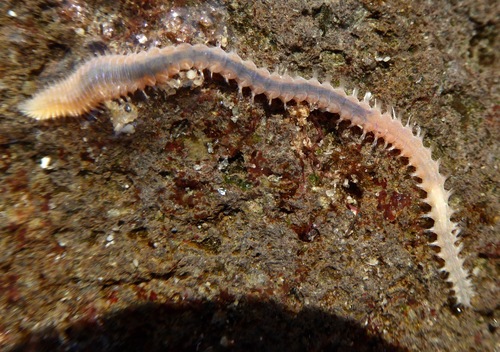
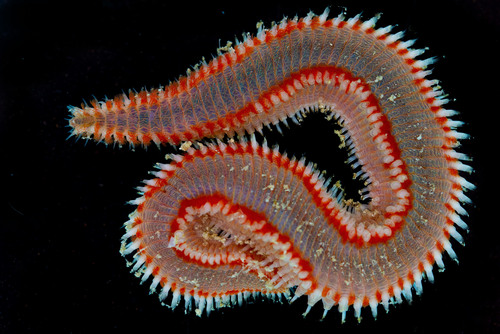
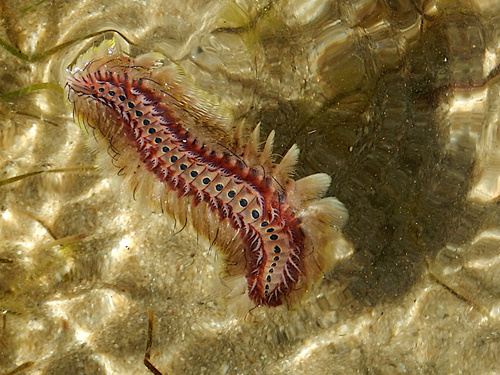
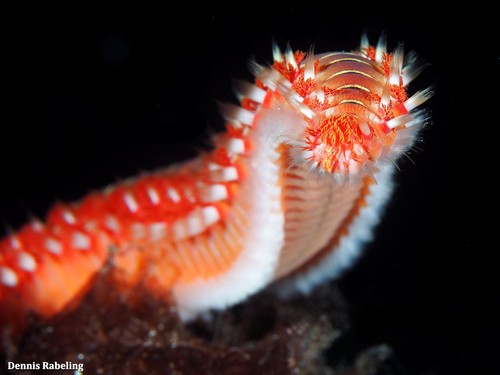
Hermodice carunculata, commonly called the bearded fireworm, has an average length of 15 cm (6 inches), and can grow up to 30 cm (12 inches) long. At first glance, it resembles a centipede due to its elongated, flattened body form, multiple body segments, white bristles, and side-located parapodia and gills. Its body color varies widely, ranging from greenish, yellowish, and reddish to grayish or white, with a characteristic pearly glow. The body is made up of 60 to 150 identical segments, separated from one another by a thin white line and each protected by a cuticle. Each segment bears one pair of bilaterally arranged parapodia, which are structures used for locomotion, along with clusters of stinging white bristles, and red or orange gills. The anterior region of the worm can be identified by a small growth called a caruncle, which matches the color of the worm’s gills, on its first four body segments. The mouth is located ventrally on the second body segment. The head sits on the first body segment, and contains the eyes and other sensory organs. Bearded fireworms live throughout tropical coastal waters of the Atlantic Ocean. On the eastern Atlantic coast, they are found from Algeria to Liberia; on the western Atlantic coast, they range from the southeast coast of the United States to Guyana, including the Gulf of Mexico and the Caribbean Sea. They are also present in the Mediterranean Sea, especially around the Italian coast. Distinct population structure exists between the H. carunculata population found in the Caribbean and Brazil, and populations from the eastern Atlantic (Canary Islands) and eastern Mediterranean. This species occupies many shallow water marine habitats from the surface down to 40 m (130 feet) deep, including areas with corals, rocks, mud, sand, posidonia, drifting wood, and port infrastructure.