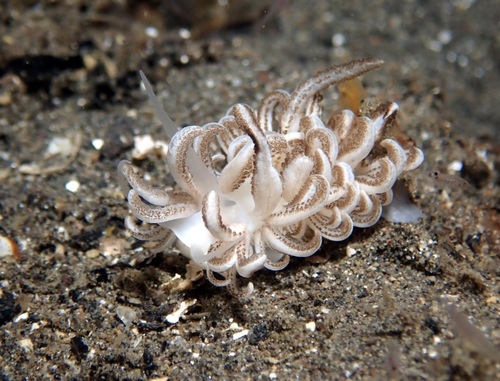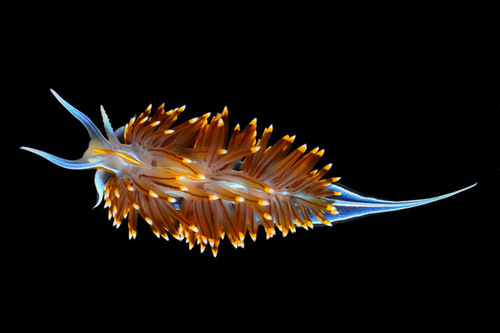
About Hermissenda opalescens (J.G.Cooper, 1863)
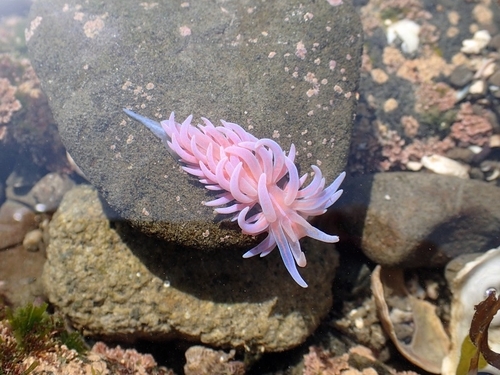
This species, Hermissenda opalescens, reaches a maximum length of about 50 mm, which equals approximately 2 inches. This sea slug has been used as a model organism in many different research areas. These areas include studies of classical conditioning, memory consolidation, associative learning, neural circuit structure, and neural physiology. It has also been used for research into ultrastructure, anatomy, larval ecology, reproductive ecology, behavioral ecology, pharmacology, and toxicology, including investigations into Beta thymosins. Unfortunately, none of these past studies distinguished between the three recognized species within the genus Hermissenda.
This nudibranch was originally described from specimens collected in San Diego, California, United States. It has been recorded along the Pacific coast from Northern California, United States, south to Punta Eugenia, Mexico. The distribution of Hermissenda opalescens overlaps with that of Hermissenda crassicornis in Northern California; H. crassicornis ranges further north to Alaska. These two species were consistently treated as a single single species for the last 90 years. Hermissenda opalescens has also been observed in Bahia de los Angeles, in the Gulf of California.
This sea slug can be found in a variety of marine habitats, including the intertidal zone of rocky shores, as well as in bays and estuaries.