About Hermetia illucens (Linnaeus, 1758)
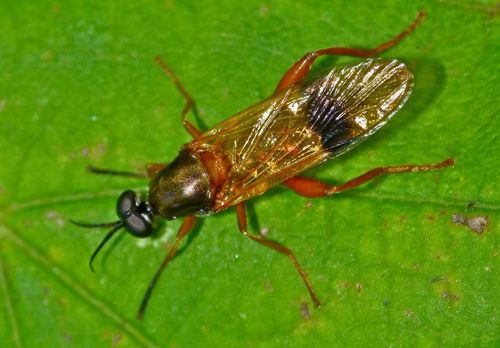
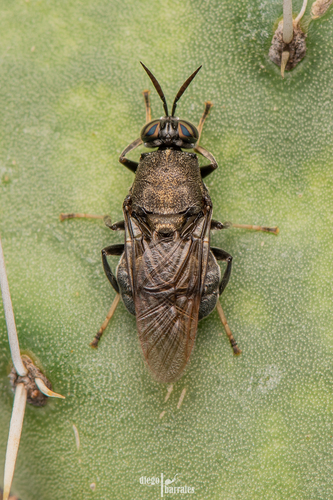
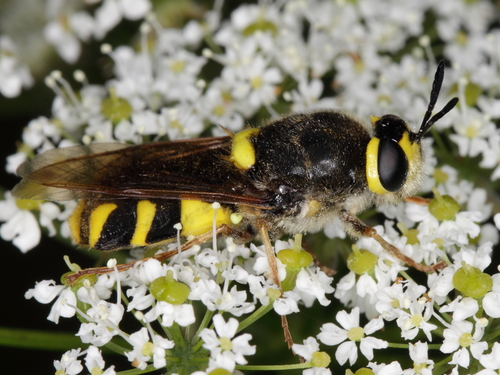
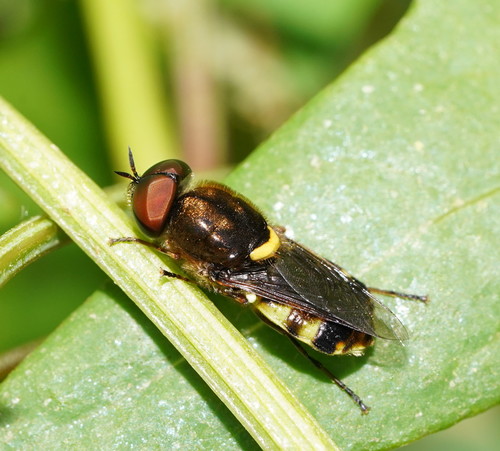
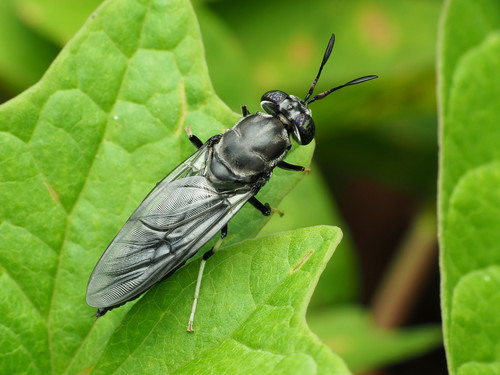
Adult black soldier flies (Hermetia illucens) measure around 16 millimetres (5⁄8 in) in length. These medium-sized flies have a largely black body, with blue to green metallic reflections on the thorax, and sometimes a reddish-tipped abdomen. The second abdominal tergite has translucent areas, which is the origin of the species’ Latin specific epithet. Their head is wide, with very well-developed eyes. Their antennae are roughly twice the length of the head. Their legs are black with whitish tarsi. The wings are membranous; when at rest, they are folded horizontally over the abdomen and overlapped. H. illucens is a mimic fly, very similar in size, color, and overall appearance to the organ pipe mud dauber wasp and its related wasp species. This mimicry is further enhanced by the fly’s elongated, wasp-like antennae, pale hind tarsi, and two small transparent "windows" on the basal abdominal segments that make the fly look like it has a narrow "wasp waist". Black soldier fly larvae can be distinguished from blowfly or housefly larvae by a thin gray-black stripe on their posterior ends. This species is native to the Neotropical realm, but has spread across all continents in recent decades, becoming nearly cosmopolitan. It is found in parts of North America and Europe, including the Iberian Peninsula, southern France, Italy, Croatia, Malta, the Canary Islands, and Switzerland, as well as on the Black Sea coast of Krasnodar, Russia. It also occurs in the Afrotropical realm, the Australasian realm, the east Palaearctic realm, the Nearctic realm, North Africa, Southern Africa, and the Indomalayan realm, including South Asian countries such as India and Pakistan. Neither the larvae nor adults of H. illucens are considered agricultural pests or disease vectors. Black soldier fly larvae act as essential decomposers, similar to redworms, breaking down organic substrates and returning nutrients to the soil. The larvae have very large appetites, so they can be used to compost household food scraps and agricultural waste. Additionally, black soldier fly larvae serve as an alternative protein source for aquaculture, animal feed, and pet food. The larvae are produced and processed at industrial-scale insect factories globally by biotechnology companies including LIVIN farms, InnovaFeed and Protix; Protix operates the world's largest insect factory farm in the Netherlands. Reliable records of human consumption of H. illucens are scarce. In 2013, Austrian designer Katharina Unger invented a table-top insect-breeding farm called "Farm 432", which allows people to produce edible fly larvae at home. This multi-chambered plastic machine resembles a kitchen appliance, and can produce 500 grams (1.1 lb) of larvae, enough for two meals, per week. The taste of the larvae is reported to be quite distinctive. According to Unger, when cooked, they smell similar to cooked potatoes, with a texture that is slightly hard on the outside and soft like meat on the inside, and a nutty, moderately meaty taste. H. illucens could be a feasible feedstock for biodiesel production.