About Hericium erinaceus (Bull.) Pers.
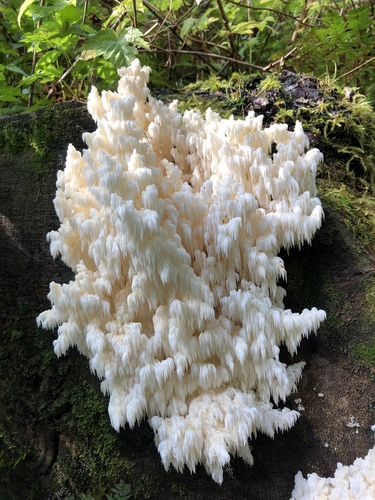
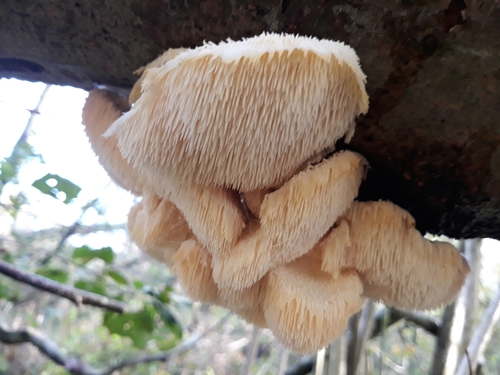
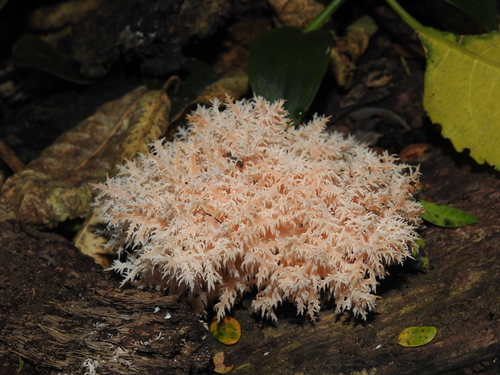
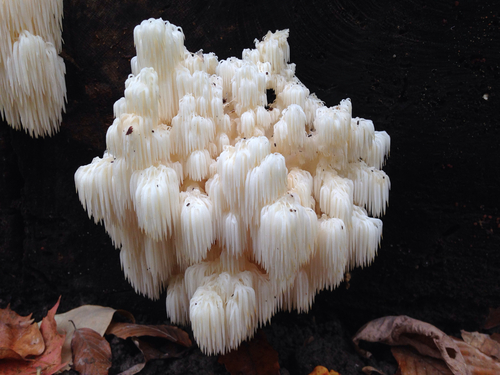
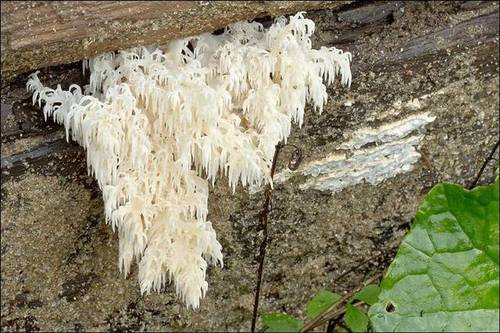
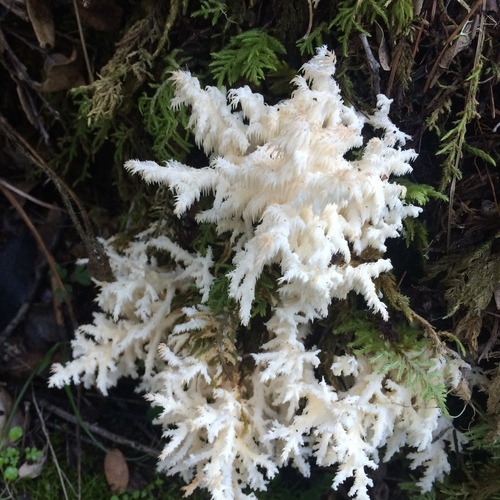
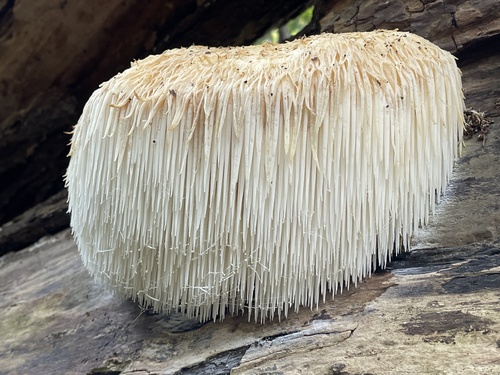
The fruit bodies of Hericium erinaceus are large, irregular bulbous tubercules. They measure 5–40 centimetres (2–15+1⁄2 inches) in diameter, and are dominated by crowded, hanging, spore-producing spines that are 1–5 cm (1⁄2–2 in) long or longer. Its hyphal system is monomitic and amyloid, made up of thin- to thick-walled hyphae that are approximately 3–15 microns wide. The hyphae also contain clamped septa and gloeoplerous elements filled with oily, resinous substances, which can enter the hymenium as gloeocystidia. The basidia are 25–40 μm long and 5–7 μm wide, each holding four spores and bearing a basal clamp. The white amyloid spores are around 5–7 μm in length and 4–5 μm in width, with a shape described as subglobose to short ellipsoid, and a spore surface that is smooth to finely roughened.
In terms of distribution and habitat, in Europe, H. erinaceus produces fruit bodies annually mainly from August to November. In North America, fruit bodies appear from October to February in western regions, from July to October in the Mountain states, and from September to February in eastern regions. In the wild, lion's mane (the common name for this species) is usually associated with tree wounds, and causes a white pocket rot. Decayed tree tissue becomes spongy and eventually disintegrates to form a cavity. The distinctive fruiting bodies (basidiocarps) generally grow near the edges of old tree wounds in autumn. It may be a tree parasite, which possibly indicates an endophytic habitat. Known host trees of H. erinaceus in North America include maple, ash, oaks, and eucalyptus. In California, lion's mane has been found growing on coast live oak, canyon live oak, interior live oak, California black oak, blue oak, and valley oak. Lion's mane is able to tolerate cold temperatures and frost conditions.
In fungi cultivation, fungal strains are analogous to plant varieties in crop breeding; fungal strains are clonal descendants of a single isolation from one fungal colony grown in pure culture. Commercial production of H. erinaceus is widespread in Asia, most often using extensive production practices on wood logs or stumps. Although there is a large body of scientific research focused on Hericium spp., they are not commonly produced on an industrial scale in the West. As a result, there are few commercially available strains in the United States or Europe, and little to no breeding work for higher yield or other favorable traits has been done. Production trials in Egypt have recorded average yields of H. erinaceus of 165 g per 1 kg of growing medium. In North America, production only happens on a small scale. Most North American production is intensive indoor cultivation, with only a small number of small outdoor sites that practice log cultivation.
Hericium erinaceus has been used in traditional Chinese medicine for centuries. It is commonly marketed as a dietary supplement for its claimed benefits for memory, but lacks sufficient scientific evidence to confirm its safety or effectiveness, and product quality can vary due to inconsistent processing and labeling. While it is a generally safe edible mushroom, its efficacy and specific active compounds remain unconfirmed in vivo.