About Herichthys minckleyi (Kornfield & Taylor, 1983)
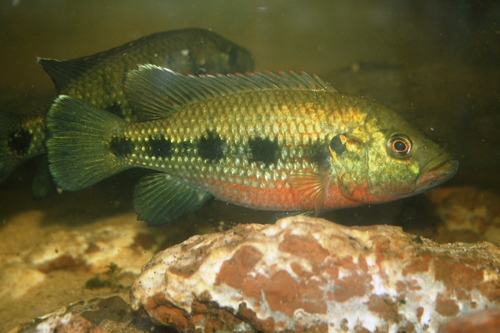
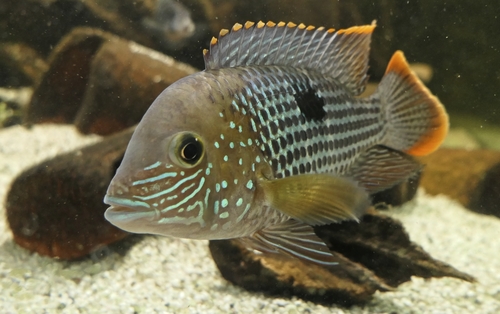
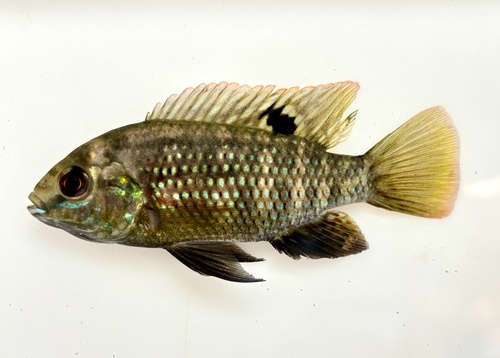
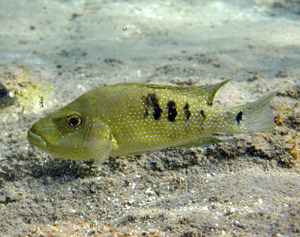
Minckley’s cichlid, scientifically named Herichthys minckleyi (Kornfield & Taylor, 1983), typically measures 70–92 mm in length, and can have either a deep or slender body. Base body color ranges across tan, light grey, yellowish green, dark green, dark brown, and black, with four to seven vertical bars on the posterior middle flank, usually overlaying faint cross-hatching. Subadults may have a spot on the rear of their body, but this marking is lost once the fish reaches adulthood. Adults can develop black speckling on their body and light speckling on their fins. The species has two separate lateral lines, an upper and a lower, and the four to seven flank bars are centered between these two lines. Body appearance can change within seconds during aggressive, competitive, or mating behaviors. This cichlid has rounded tails and rounded pectoral fins, with a slender caudal peduncle that connects the tail to the body. The Herichthys genus can often be identified by the six to seven vertical bars on the posterior middle side of member species. During breeding season, the species changes color for reproduction, displaying sexual dichromatism in its breeding appearance. H. minckleyi is distinguished from other species in its group by a longer head, longer snout, and shorter dorsal and anal fins. It can be identified by 16 spines and 11 rays on the dorsal fin, and 5 spines on the anal fin.
First described by researchers Irv Kornfield and Jeffery Taylor in 1983, Minckley’s cichlid is endemic to the butterfly-shaped Cuatro Ciénegas Basin in Coahuila, Mexico. This intermontane basin holds nitrogen- and phosphorus-poor spring-fed ecosystems, has high levels of endemism, receives less than 200 mm of rainfall per year, and is supported by groundwater. The basin sits 750 m above sea level, with surrounding mountains reaching 2500 m above sea level. It is known for its diverse fish fauna, to which H. minckleyi contributes a unique lineage. Within the basin, the species occurs in springs, streams, ponds, and lagunas. It is the northernmost species of the broader H. cyanoguttatus species group.
Minckley’s cichlid is the only species in the Herichthys genus that demonstrates sexual dichromatism, where males and females have distinctly different color patterns during mating. This trait evolved after the species diverged from other living Herichthys. During breeding, females typically turn white with black markings along their sides, while males turn solid dark green or black with pale bluish spots on their fins. Solid black male coloration correlates with competitive behaviors, while lighter male coloration correlates with pair-bonding behaviors. Color variation is common, and individuals do not always fully express breeding coloration; partial color change is frequently observed. H. minckleyi is a polygynous species, where one male mates with multiple females. Males guard a territory of several square meters that holds their females. When females are brooding, they become reclusive until their offspring are able to swim independently, after which the female guards her young. After spawning, H. minckleyi provides parental care in a different pattern than the closely related cichlid H. cyanoguttatus. Males of H. minckleyi stay with females less often after mating, and perform fewer defensive attacks to protect offspring than males of the related species. Unlike many of the species’ unique traits, the tendency for males to be absent from the nest is an ancestral evolved trait from its evolutionary lineage, rather than a species-specific adaptation to the unique environmental pressures of the Cuatro Ciénegas Basin.
Currently, Minckley’s cichlid is listed as Endangered on the IUCN Red List, meaning it faces a high risk of extinction in the wild.