About Herennia multipuncta (Doleschall, 1859)
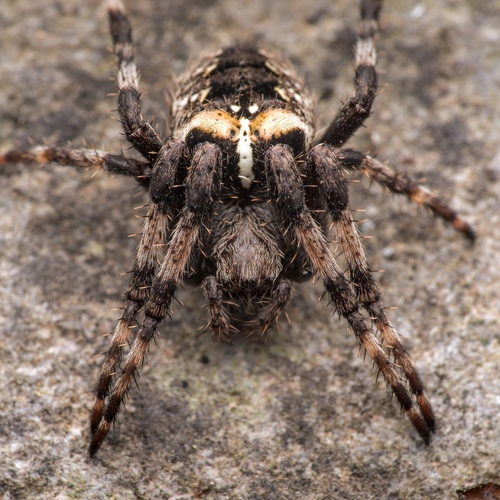
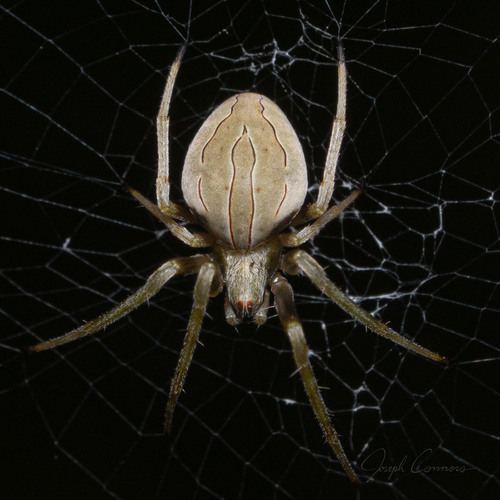
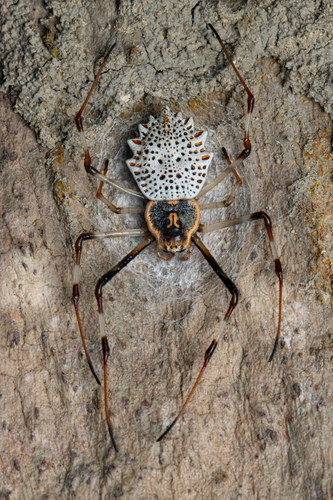
Herennia multipuncta is a species of spider first described by Doleschall in 1859. Females have a hairy, reddish-brown cephalothorax that is longer than it is wide and narrower at the front. A yellowish, U-shaped patch is located near the front of the cephalothorax, with darker markings further back. Their mouthparts are yellowish-brown, and their long, slender, hairy, spiny legs are mostly brown. The female's abdomen has a flattened, pale grey dorsal surface with five pairs of sigilla, which are puncture-like spots that mark internal muscle attachment points. The dorsal surface also has numerous grey specks and a few dark streaks near the back. Males are reddish-brown with dark legs. Males have a total body length of 5 to 7 mm (0.2 to 0.3 in), which is about half the length of females, which measure 10 to 14 mm (0.4 to 0.6 in). This spider rests head-down on its web with its legs flexed, and its natural colouring provides effective camouflage. Herennia multipuncta occurs in tropical regions of southern Asia, with a confirmed range that includes India, Malaysia, China, and New Guinea. The species is often associated with humans, has spread to other countries, and is considered invasive there. Its typical habitat includes tree trunks and building walls, where it builds a small web close to the surface. Newly built webs start as orb webs, anchored to prominences on the underlying surface. As the spider grows, the web grows with it; over time, the web allometrically develops into a substrate-dependent ladder web with parallel side frames instead of rounded ones, and the web's hub is modified into a silken cup. This species is classified as both invasive and synanthropic.