About Heracleum sphondylium L.
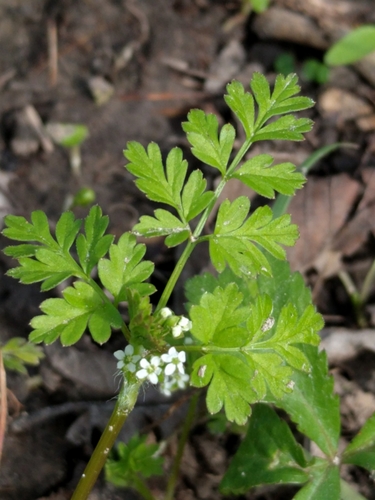
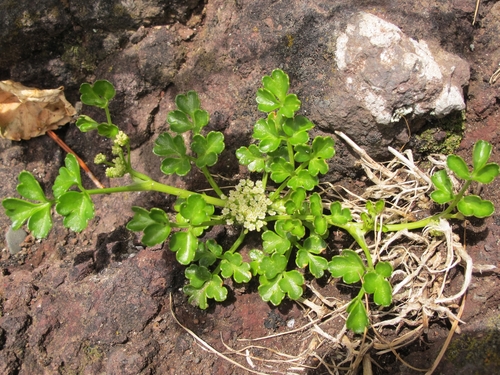
Heracleum sphondylium L. is a herbaceous flowering plant. It is a tall, roughly hairy species that grows up to 2 metres (6 ft 7 in) in height. Its hollow, ridged stem, covered in bristly hairs, grows from a large tap root. Its leaves can reach 50 centimetres (20 in) in length; they are once or twice pinnate, hairy, serrated, and divided into 3–5 lobed segments. Heracleum sphondylium is most commonly a polycarpic perennial plant, not a biennial as sometimes claimed.
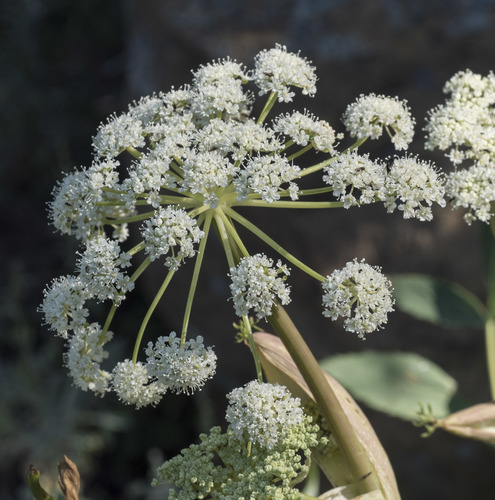
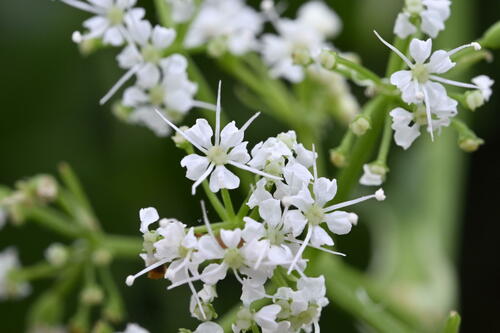
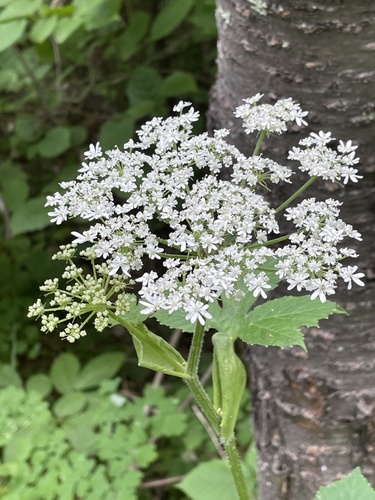
Its flowers are arranged in flat or slightly convex umbels that are 4–25 cm in diameter. Umbels usually have 10–25 hairy, somewhat unequal rays, each 2–12 cm long. Each flower has five white petals; rarely, petals are pinkish-white to purplish. The central flowers of the umbel have radial symmetry (actinomorphic), while the flowers around the perimeter of the umbel have bilateral symmetry (zygomorphic), because the outermost petals are enlarged. The winged fruits are flattened schizocarps, elliptical to rounded and glabrous, about 7–12 mm long. The common name hogweed likely comes from the plant's characteristic 'farm yardy' smell, or from the observation that pigs eat its foliage and roots. Heracleum sphondylium is smaller than Heracleum mantegazzianum (giant hogweed) and Heracleum sosnowskyi (Sosnowsky's hogweed). It contains some of the same phytophototoxic furanocoumarin compounds, but at much lower concentrations. There is evidence that sap from common hogweed can cause phytophotodermatitis (burns and rashes) in sensitive people when contaminated skin is exposed to sunlight.
Heracleum sphondylium is native to most of Europe, western Asia and northern Africa. For example, it occurs in southern and southwestern Poland, but is much less common in other parts of the country. The species has been introduced into North America. It has specifically been introduced to eastern Canada, but reports of H. sphondylium in Canada are rare. Some authorities state that Heracleum sphondylium subsp. sibiricum, a synonym of Heracleum sibiricum, has been introduced in the United States, but botanists in New England have not been able to identify the taxon to subspecies rank. The plant is common in grassland, herb-rich meadows, hedges, woods, road verges, railway embankments, waste ground, and cultivated ground. It grows especially well on moist, nitrogen-rich improved soils. It can grow in mountain areas up to 2,500 m (8,200 ft) in altitude.
In Europe, the primary flowering season of Heracleum sphondylium subsp. sphondylium runs from June to September, with peak flowering in July and peak seed ripening in August. In Great Britain, seed dispersal happens in late September and early October, which usually coincides with winds tied to the September equinox. The flowers are pollinated by insects including beetles, wasps, and especially flies. As its name suggests, the small picture-winged fly Euleia heraclei lives on hogweed. The leaves are commonly mined by the larvae of the leaf miner Phytomyza spondylii. Heracleum sphondylium ranked in the top 10 for most nectar production (nectar per unit cover per year) in a UK plant survey conducted by AgriLand, a project supported by the UK Insect Pollinators Initiative.
Borscht originates from an ancient soup originally made from pickled stems, leaves and umbels of common hogweed. Many foragers consider the young shoots of this plant to be excellent food. In eastern European countries, and especially Romania, H. sphondylium is used as an aphrodisiac, and to treat gynecological conditions, fertility problems, and impotence. It is also sometimes recommended for epilepsy. However, no clinical studies exist to prove it is effective for treating any of these conditions. The seeds can be dried and used as a spice, with a flavour similar to cardamom.