About Heptacodium miconioides Rehder
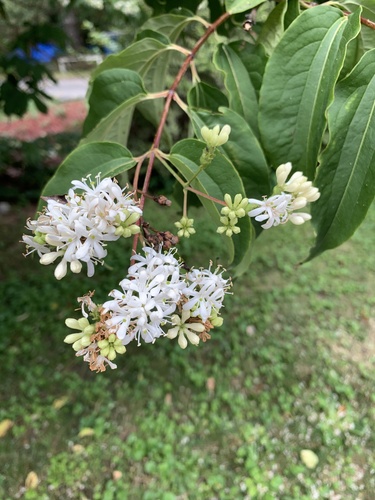
Heptacodium miconioides Rehder is a deciduous large shrub or small tree that typically grows 4–9 m (13–30 ft) tall. Its trunk has thin, papery, light tan bark that peels off in strips or sheets. The plant’s upright, spreading quadrangular branches form a rounded, often irregular overall shape. Its dark green, heart-shaped leaves grow in opposite pairs, measure 8–10 cm long by 5–6 cm wide, have smooth entire edges, and feature deeply impressed veins that run parallel to the leaf margin. In September, Heptacodium miconioides produces abundant large displays of small fragrant white flowers, which attract honey bees, solitary bees, bumblebees, and butterflies; in North America, they also attract hummingbirds. Each flower has five petals and measures less than 13 mm across. After the white flower corollas fall, the calyces develop into expanded deep red lobes that remain on the plant through November. In the wild, the species grows in scrub habitats, woodlands, and along the margins of broadleaved evergreen forests, often growing on cliffs, at altitudes between 600 and 1000 metres. For cultivation, Heptacodium miconioides can be easily propagated from either seed or softwood cuttings. It has become widely available in nurseries across North America and Europe, and was stocked by 26 nurseries in the United Kingdom alone in 2011. This species is extremely hardy, and tolerates temperatures as low as −35 °C (−31 °F). It is also fast-growing, reaching 3 m (9.8 ft) tall in just five years, and is highly tolerant of shade. All six of the first Heptacodium miconioides individuals planted in the United States in 1980 at the Arnold Arboretum remain alive as of current records, indicating the species has an expected lifespan of more than 40 years. This plant has been awarded the Royal Horticultural Society's Award of Garden Merit. Regarding potential medicinal use, recent tests have shown that extracts from this plant have antibacterial activity. Leaf blades of Heptacodium miconioides have been found to contain flavonoids, tannins, alkaloids, saponins, lignin, and chlorogenic acid.