About Hephaestus fuliginosus (Macleay, 1883)
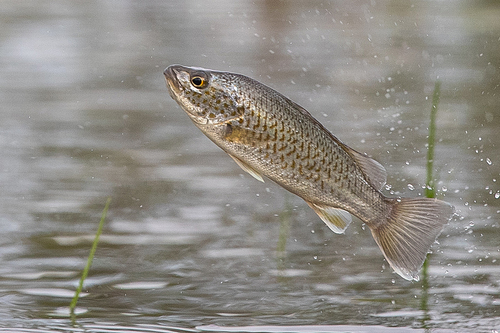
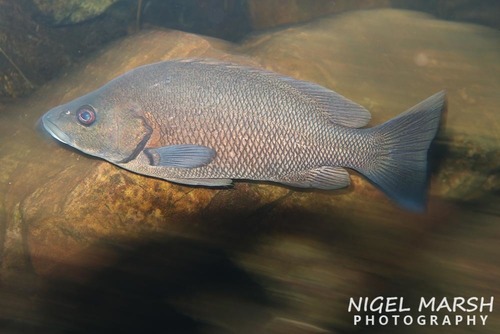
The sooty grunter, Hephaestus fuliginosus, is a relatively large grunter species. Its body color ranges from brownish-grey to sooty-black, with darker scale margins; some adult specimens may have golden blotches on their sides. Juvenile sooty grunters have dark blotches on the anal fin and the soft-rayed section of the dorsal fin. This species has a discontinuous lip fold on the ventral side of the lower mandible, and some individuals develop thick, fleshy lips as they mature. Their bodies are moderately deep, oblong to oval in shape, and laterally compressed, with a dorsal profile that bulges between the nape and the origin of the dorsal fin. They have an oblique mouth: in young fish, the maxillary reaches the level of the front edge of the eye, and the gap between the maxillary and the eye grows larger as the fish ages. The teeth are conical, slightly recurved, arranged in bands, with the outer row teeth being the largest. There are no teeth on the roof of the mouth. Sooty grunters have a continuous dorsal fin with 11 to 12 spines and 12 to 14 soft rays; the spiny section of the fin is arched, with the fifth to seventh spines being the longest, and the soft rays are longer than the spines. The anal fin holds three spines and 8 to 10 soft rays, and the caudal fin has a slightly curved, marginate edge. The maximum recorded fork length of this species is 54 centimetres (21 in), while the more common standard length is around 25 centimetres (9.8 in), and the maximum recorded weight is 6.2 kilograms (14 lb). The sooty grunter was first formally described as Therapon fuliginosus in 1883 by Scottish-Australian naturalist William John Macleay, with its type locality recorded as the Upper Burdekin River in northern Queensland. Its specific name, fuliginosus, comes from the Latin word fuligo meaning soot, and refers to the species' characteristic sooty coloration. The sooty grunter is endemic to northern Australia, ranging from the upper Burdekin River in Queensland to the Daly River in the Northern Territory. It is absent from the Cape York Peninsula. Reports of the species from southern New Guinea actually refer to an undescribed separate species. The sooty grunter has been widely translocated within Australia. Sooty grunters live in large flowing freshwater streams, and prefer rapidly flowing water with rocky bottoms and sparse aquatic plant cover. This species can tolerate acidic conditions down to a pH of 4.0, and water temperatures between 12 and 34 °C. It is an omnivorous species, and has been recorded feeding on frogs, insects, worms, crustaceans, algae, plant roots, and palm berries. Sooty grunters spawn in summer, when monsoon rains raise water levels, and may spawn in groups. After fertilization, males guard and fan the eggs.