About Hepatica nobilis Schreb.
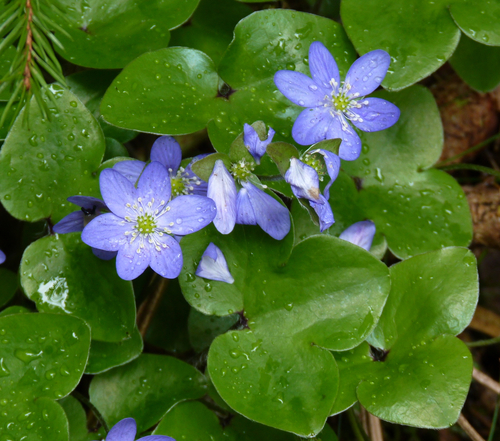
This plant, also known as Anemone hepatica and with the accepted scientific name Hepatica nobilis Schreb., grows 5–15 cm (2–6 inches) tall. Its leaves and flowers emerge directly from the rhizome, rather than from an above-ground stem. The leaves are three-lobed, fleshy, hairless, 7–9 cm (2+3⁄4–3+1⁄2 inches) wide, and 5–6 cm (2–2+1⁄4 inches) long. The upper leaf surface is dark green with whitish stripes, while the lower surface is violet or reddish brown. Leaves emerge during or after flowering and stay green throughout winter. The flowers can be blue, purple, pink, or white, and appear in winter or spring. They have five to ten oval showy sepals and three green bracts. This species grows in woods, thickets, and meadows, most commonly in the mountainous regions of continental Europe, North America, and Japan. Hepatica flowers produce pollen but no nectar. In North America, flowers first attract Lasioglossum sweat bees and small carpenter bees that search unsuccessfully for nectar. When the stamens begin releasing pollen, the bees return to collect and feed on the pollen. Mining bees will sometimes visit the flowers, but they prefer flowers that produce both nectar and pollen. Like other members of the Ranunculaceae family, fresh liverwort contains protoanemonin, making it slightly toxic. When the herb is dried, protoanemonin dimerizes into non-toxic anemonin. Medieval herbalists believed this plant could be used to treat liver diseases, and it may still be used in modern folk medicine. Under the synonym name Hepatica nobilis, this plant has earned the Royal Horticultural Society's Award of Garden Merit.