About Henricia pumila Eernisse, Strathmann & Strathmann, 2010
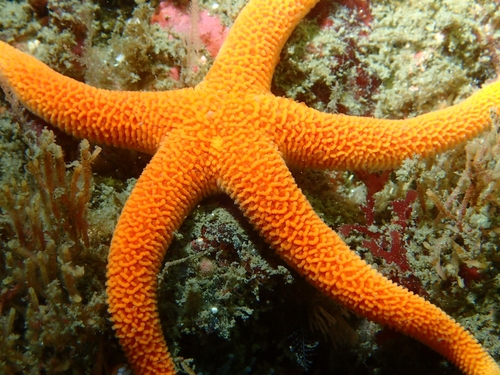
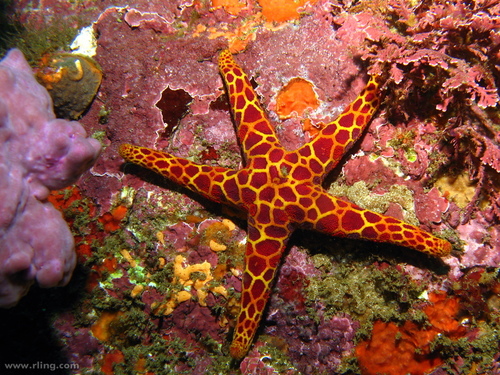
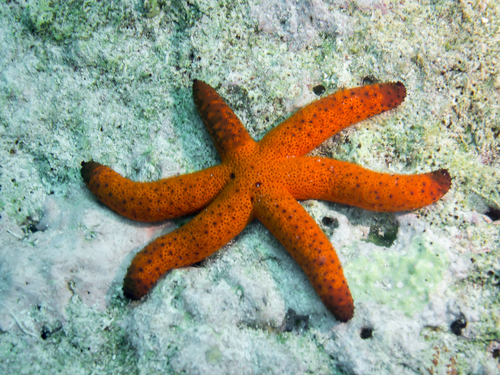
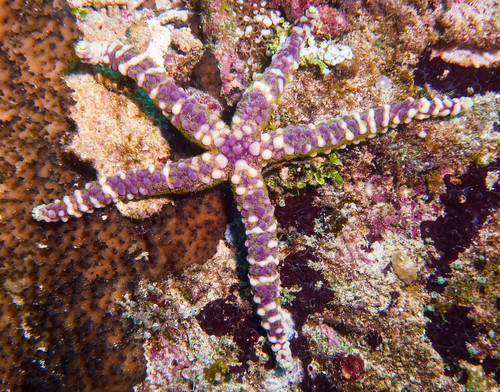
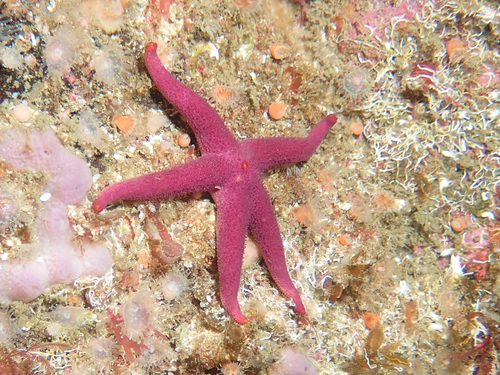
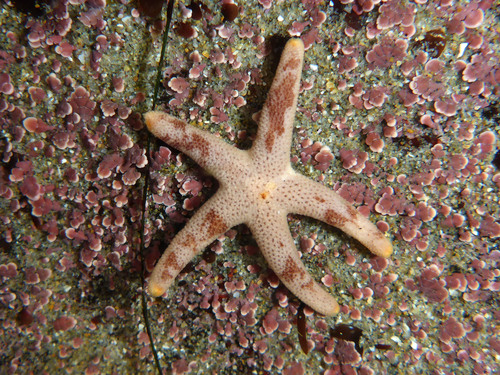
This species is commonly called the dwarf mottled henricia, with the scientific name Henricia pumila. It typically has five short, slender arms, also called rays, that taper evenly to a blunt tip. Individuals with four or six arms exist but are rare. The aboral, or dorsal, side of its body can be orange, reddish orange, or purplish red, mottled with pale orange, cream, or lavender, while its oral, or ventral, side is yellow or cream. Its aboral surface is dotted with pseudopaxillae, which are columnar skeletal plates topped with small spines. These pseudopaxillae hold brush-like clusters of crystalline spines, giving the dwarf mottled henricia a textured surface. Like all other starfishes, H. pumila moves using tube feet. H. pumila lives in cool, shallow waters of the eastern Pacific Ocean, along the North American coast from near Sitka, Alaska, to Ensenada, Baja California. It is much less common across the Southern California portion of its range, with only a small number of sightings along the coasts of the Channel Islands, Santa Barbara, and San Diego. It is often found in the low intertidal zone, and can be seen in tide pools during low tide. The dwarf mottled henricia is a brooding species, and has been observed brooding its young between January and April. It is generally assumed that H. pumila has separate male and female sexes, but it is possible that the species may have hermaphroditic tissues, a trait seen in some other brooding marine invertebrates. After eggs are released through the oral gonopores, the brooding parent wraps its arms in a spiral around a raised oral disc. Embryos are kept under this structure until they develop and emerge as free-crawling juveniles.