About Henricia leviuscula (Stimpson, 1857)
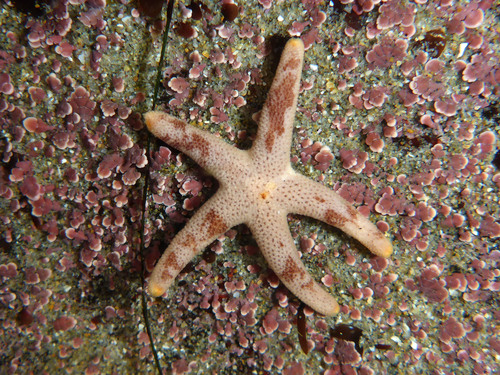
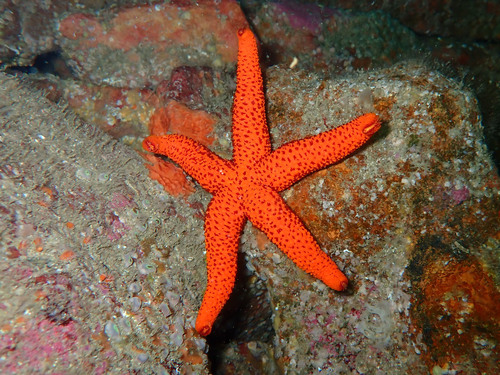
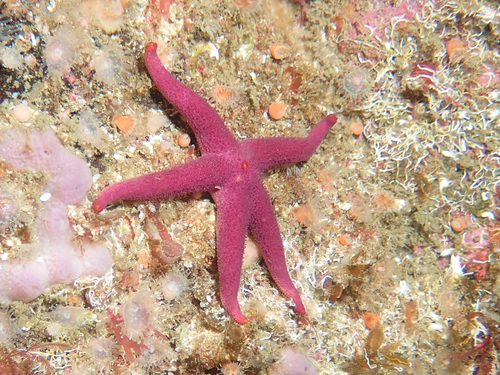
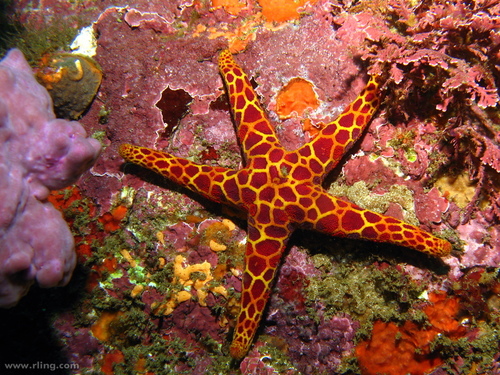
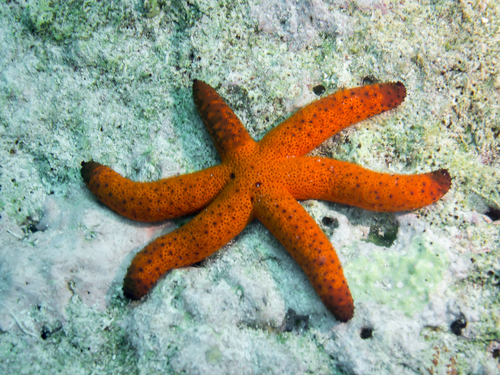
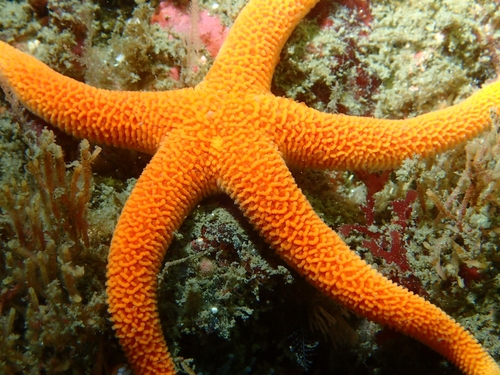
This species, Henricia leviuscula, can usually be identified by its bright orange-red color, though color varies widely from tan to almost purple. The central disk may be mottled gray, and individuals can have a saddle-like marking made of lilac blotches between the rays; the rays themselves are not mottled. Individuals most commonly have 5 rays, though they may occasionally have 4 to 6. The rays are smooth to the eye and touch, because this species lacks both pedicellariae and spines. Henricia leviuscula is a relatively small seastar; its full diameter is usually over 8 cm, and it rarely grows larger than 12 cm across. Like all seastars, the blood star has a visible madreporite. Its distribution range extends from Alaska to Baja California. It inhabits the intertidal zone, found under rocks and in other protected locations, from the low-tide line down to approximately 400 m deep. It often hosts the commensal scaleworm Arctonoe vittata. For reproduction and life history, the sexes of this species are dioecious. One source states females are not known to brood their young, but this conflicts with other reports that smaller females do brood their young while larger females release eggs directly into the water without brooding. This conflicting information has led biologists to suspect that Henricia leviuscula as currently defined is a species complex. Its embryonic stages do not stick to one another, and instead float freely. After hatching, larvae are ciliated and able to swim. Spawned eggs of this species have been measured at 1342 μm in diameter.