About Heniochus singularius Smith & Radcliffe, 1911
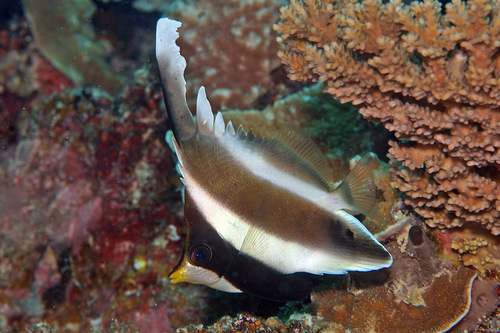
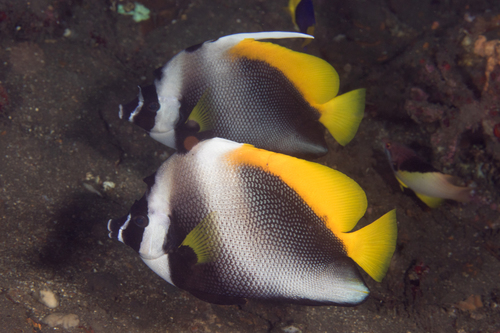
Adults and juveniles of Heniochus singularius differ noticeably in appearance. Juveniles have an elongated fourth spine on the spiny portion of the dorsal fin, which forms a white banner and makes the fish's triangular shape more distinct. In adults, this banner is much shorter, resulting in a fuller body shape that more closely matches the typical shape of butterflyfish. The species' body colour pattern starts with a white band circling the mouth, followed by a series of black bands. The first of these black bands is an eye stripe that runs from above the eye down to the chin. After the eye stripe, a second black band crosses the middle of the body to the front of the dorsal fin. The final black band runs diagonally from the start of the soft-rayed portion of the dorsal fin to the rear of the anal fin. The soft-rayed portion of the dorsal fin and the caudal fin are bright canary yellow. On adult individuals, the area of the body between the black bands has a fine reticulated pattern, and adults also have a bony bump on the head. The dorsal fin of this species holds 11 to 12 spines and 25 to 27 soft rays, while the anal fin has 3 spines and 17 to 18 soft rays. Heniochus singularius reaches a maximum total length of 30 centimetres (12 inches), making it the largest species in the genus Heniochus. This species has a wide distribution across the Indo-Pacific, ranging from the central Indian Ocean around the Maldives and Chagos Islands east to Samoa. Its range extends north to southern Japan and south to northern Australia. In Australia, it occurs from Shark Bay to the Dampier Archipelago and on offshore reefs of Western Australia, along the northern Great Barrier Reef south to Moreton Bay in Queensland, and also at Christmas Island. Heniochus singularius inhabits coastal, inner, and outer reef slopes, and it prefers areas with abundant coral growth and varied topography. Juveniles are most commonly found in shallow lagoons, though they can also occur in deeper water near caves and rock shelters. The species feeds on coral polyps (possibly including live coral), benthic invertebrates, and algae. It is oviparous, and breeding individuals form pairs.