About Heniochus intermedius Steindachner, 1893
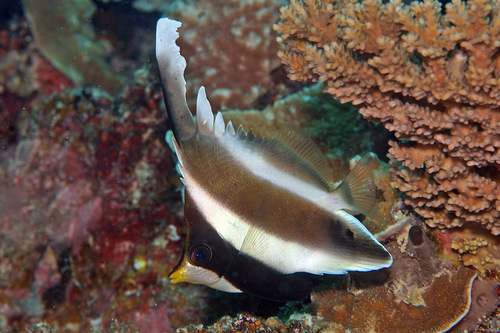
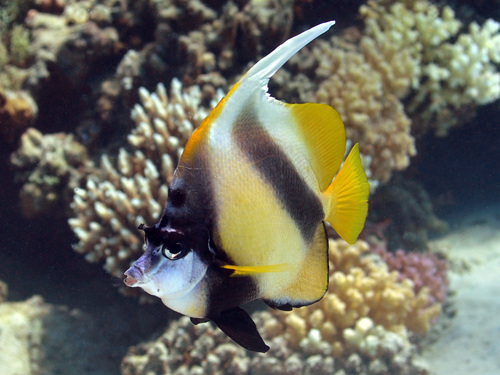
The Red Sea bannerfish (Heniochus intermedius Steindachner, 1893) has a deeply compressed body, colored pale yellow that fades to white on the back towards the head. It has two wide, angled oblique vertical blackish bands, which are darker below and become more diffuse towards the back. The forward band starts at the origin of the dorsal fin, adjacent to or over the eye, and runs to the pelvic fin. The rear band starts at the spiny part of the dorsal fin and runs to the rear part of the anal fin. The pectoral fin, the soft part of the dorsal and anal fins, and the caudal fin are yellow, while the pelvic fins are black. A very elongated white filament extends from the anterior part of the dorsal fin; this filament moves while the fish swims, resembling a banner blowing in the wind. The dorsal fin has 11 spines and 25-26 soft rays, while the anal fin has 3 spines and 17-18 soft rays. This species reaches a maximum total length of 18 centimetres (7.1 in).
This species is native to the western Indian Ocean, where it occurs in the Red Sea and the Gulf of Aden. It has been introduced to waters off southeastern Florida, probably from escapes or releases from the aquarium trade. It has recently been recorded in the Gulf of Antalya, on the Mediterranean coast of Turkey, after likely introduction through the Suez Canal from the Red Sea, and remains very rare there.
The Red Sea bannerfish is associated with coral reefs. It is most often found solitary or in pairs, though large schools have been recorded. Juveniles form large schools, particularly on deep reefs with low coral density. They feed on both zooplankton and benthic invertebrates, but how much they feed on live coral has not yet been determined. It is an oviparous species that forms monogamous pairs for spawning.