About Heniochus diphreutes Jordan, 1903
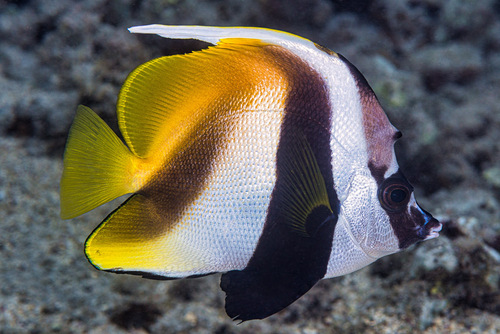
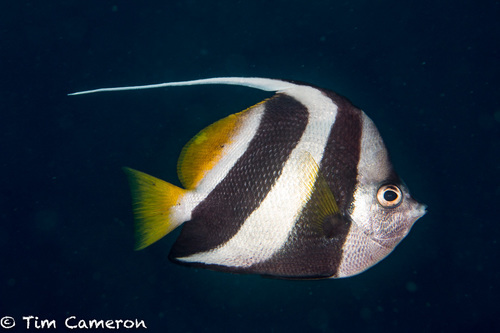
The schooling bannerfish (Heniochus diphreutes Jordan, 1903) is a small fish that reaches a maximum length of 18–21 cm. Its body is laterally compressed, and the first rays of its dorsal fin extend into a long white filament. The fish’s base body color is white, marked with two large black diagonal bands. Past the second black stripe, the dorsal, caudal, and pectoral fins are yellow. The head is white, with black eyes connected by a black to gray band. Its short snout, which has black to gray spotting, holds a small terminal, extensible mouth. The schooling bannerfish is widespread across tropical, subtropical, and temperate waters of the Indo-Pacific. Its range extends from the eastern coast of Africa (including the Red Sea) to Polynesia and Hawaii, and from the Great Barrier Reef and southern Japan to the Kermadec Islands of New Zealand. It favors external reef slopes and channels. It has a broad depth range, and is most commonly found at depths of 5–30 m, though it can occur as deep as 210 m in some locations. As its common name suggests, the schooling bannerfish lives in large groups. It feeds on zooplankton in open water. Juveniles may act as cleaner fish, and this cleaning behavior has also been observed in adults. This oviparous species forms pairs for breeding. Individuals have been observed cleaning parasites off the short sunfish (Mola ramsayi) off the coast of the Maldives.