About Hemorrhois hippocrepis (Linnaeus, 1758)
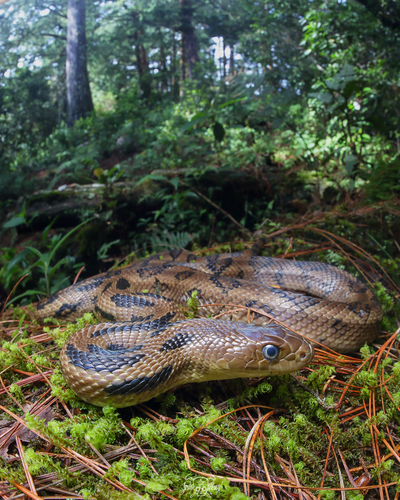
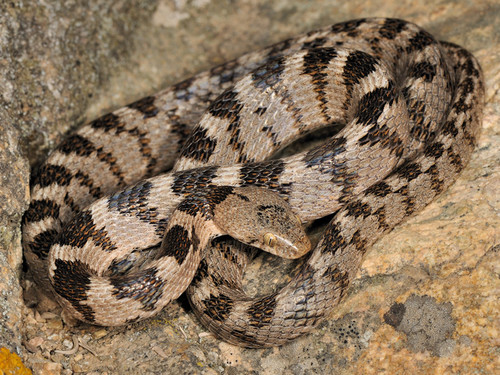
Hemorrhois hippocrepis (Linnaeus, 1758) is a species that reaches a maximum total length (including tail) of 1.5 m (5 feet) when fully grown. It has a slender body, with a head that is wider than its neck. Its eye is large, has a round pupil, and is bordered below by a row of small scales. Its smooth dorsal scales are arranged in 25 to 29 rows, and it has 220 to 258 ventral scales. Dorsally, this species has a series of large blackish or dark brown spots edged in black. Each side of the body has an additional row of smaller alternating dark spots. The lighter ground color between the spots can be yellowish, olive, or reddish. The dark spots are placed close together, creating the appearance of a dark snake that bears a light pattern resembling a chain or a series of X shapes. It also has a light, horseshoe-shaped mark on the neck and the back of the head. H. hippocrepis occurs in North Africa across Algeria, Morocco, and Tunisia. In Europe, it is found in southern and central Portugal, southern, eastern, and central Spain, Gibraltar, southern Sardinia, and Pantelleria Island; it may have been introduced to these island locations. Since the early 2000s, it has also been reported from the Balearic Islands of Mallorca, Ibiza, and Formentera, where it was likely introduced via old olive trees imported from mainland Spain. The species is successfully established on the Balearic Islands, and grows larger there than it does on the mainland. Its natural habitats include Mediterranean-type shrubby vegetation, rocky areas, rocky shores, sandy shores, arable land, pastureland, plantations, rural gardens, and urban areas. H. hippocrepis is oviparous, meaning it reproduces by laying eggs.