About Hemitrygon fluviorum (Ogilby, 1908)
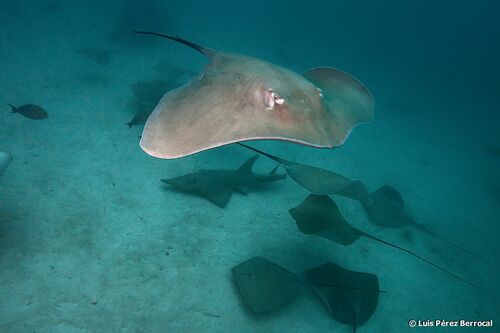
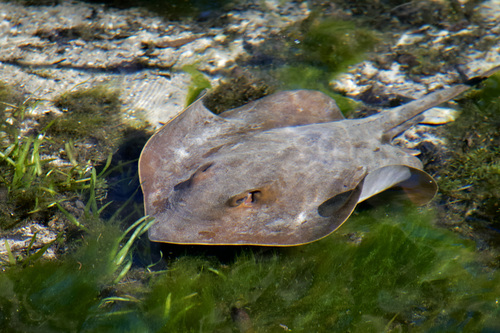
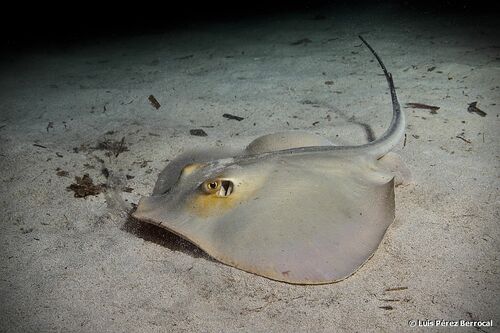
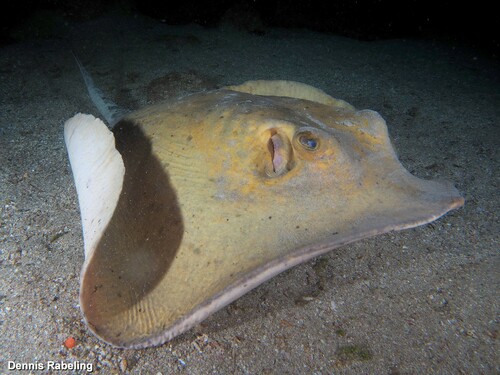
The estuary stingray, Hemitrygon fluviorum, has a diamond-shaped pectoral fin disc roughly as wide as it is long, with gently convex front edges and broadly rounded outer corners. Its snout is wide and triangular, tapering to a point. Small, widely spaced eyes sit directly in front of the spiracles. Between the long, narrow nostrils, there is a short, broad "skirt" of skin with a weakly fringed back margin. The small, bow-shaped mouth is surrounded by deep furrows, and holds a row of five papillae across its floor; the outermost pair are tiny and positioned separately from the others. Its teeth are small and arranged into flat, pavement-like surfaces. Five pairs of gill slits are located beneath the disc, and the pelvic fins are relatively large. The tail is twice as long as the disc, broad and flattened at the base, and bears at least one, often two, serrated stinging spines on its upper surface. Past the spines, the tail tapers quickly to become whip-like, and has a well-developed keel on the upper side and a long, low fin fold on the underside. Wide patches of small dermal denticles with flattened crowns cover the area between the eyes and the middle of the back, alongside a midline row of enlarged thorns that grow progressively longer toward the base of the sting. The tail is smooth except for the thorns near the base. This species is yellowish to greenish brown on its upper surface, lightening toward the disc margins and darkening past the tail spine, and white underneath. It grows to at least 93 cm (37 in) across, and may reach a maximum width of 1.2 m (3.9 ft), with a maximum recorded weight of 6.1 kg (13 lb).
The estuary stingray's range extends roughly 1,700 km (1,100 mi) along Australia's eastern coast, from Repulse Bay in Queensland to the Hacking River in New South Wales. It is most common in southern Queensland, including Hervey Bay and Moreton Bay. It was formerly thought to have vanished from Botany Bay and Port Jackson since the 1880s, but recent observations confirm this assumption is incorrect. Earlier records of this species from Cape York Peninsula, the Northern Territory, New Guinea, and the South China Sea are almost certainly misidentifications of other stingrays, primarily the freshwater whipray (Himantura dalyensis) and the Merauke stingray (D. longicauda). This species has quite specific habitat requirements, and large populations are only found at particular locations. It prefers tidal rivers and the intertidal flats of mangrove-lined estuaries and bays with sandy to muddy bottoms. It is rarely found outside these sheltered areas, though it has been recorded at depths up to 28 m (92 ft) in offshore waters. It lives in marine and brackish waters, and may be able to tolerate fresh water, as it has been observed swimming upriver beyond the high tide limit. Surface water temperatures across its range vary from 24–29 °C (75–84 °F) in the north to 17–23 °C (63–73 °F) in the south, and individuals tend to segregate by size and sex.
Contrary to its reputation as a voracious predator of oysters and other farmed shellfish, the estuary stingray's natural diet consists mainly of crustaceans and polychaete worms. In Moreton Bay, an important prey item is the soldier crab (Mictyris longicarpus). This ray has been observed entering mudflats with the rising tide to forage for food. Documented parasites of the estuary stingray include the tapeworm Shirleyrhynchus aetobatidis, the nematode Echinocephalus overstreeti, and the monogeneans Heterocotyle chin, Empruthotrema dasyatidis, and Neoentobdella cribbi. Like other stingrays, the estuary stingray reproduces through aplacental viviparity: developing embryos are first nourished by yolk, then by histotroph, or "uterine milk", produced by the mother. Females likely produce offspring every year. Courtship behavior, where the male follows the female and bites her disc, has been observed at night in roughly 80 cm (31 in) deep water in Hays Inlet between July and October. Newborn rays measure about 11 cm (4.3 in) across and 35 cm (14 in) long. Young rays have been caught in the Nerang and Macleay Rivers and Hays Inlet, so these fresh or brackish environments may act as nursery areas. Males reach sexual maturity at around 41 cm (16 in) across and seven years old, while females mature at around 63 cm (25 in) across and 13 years old. This difference in maturation size between sexes is one of the largest recorded among stingrays. Maximum lifespan is estimated at 16 years for males and 23 years for females.