About Hemitriccus margaritaceiventer (Orbigny & Lafresnaye, 1837)
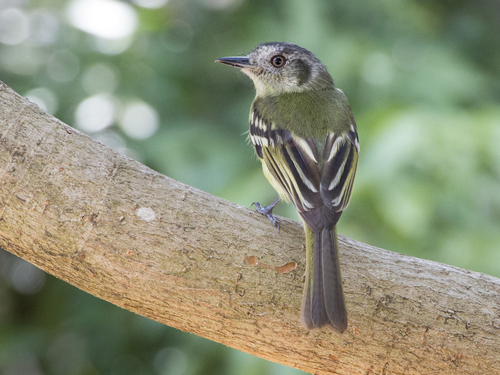
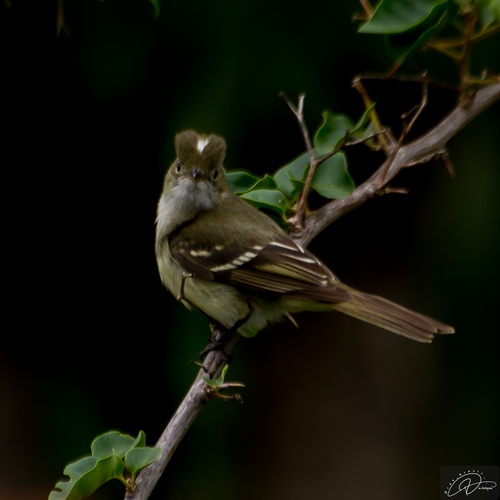
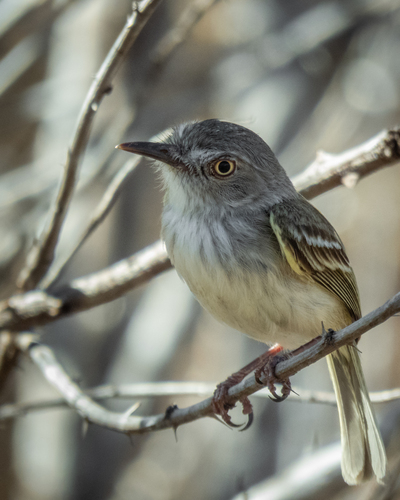
Hemitriccus margaritaceiventer, commonly called the pearly-vented tody-tyrant, was first described by Orbigny & Lafresnaye in 1837. The pearly-vented tody-tyrant is about 10 to 11 cm (3.9 to 4.3 in) long and weighs 7 to 10 g (0.25 to 0.35 oz). Males and females have identical plumage. Adults of the nominate subspecies H. m. margaritaceiventer have a gray crown. Their lores and eye-ring are whitish, set against an otherwise grayish brown face. Their back and rump are colored drab grayish brown to brownish olive. Their wings are dusky, with buff whitish to yellow edges on the flight feathers and yellowish tips on the wing coverts; the coverts’ colored tips form two distinct wing bars. Their tail is dusky. Their throat and underparts are white with faint grayish streaking. They have a pale iris, a reddish brown to blackish upper mandible, a pinkish brown to pinkish lower mandible, and pink to pale grayish pink legs and feet. The species’ other eight subspecies differ from the nominate subspecies and from each other in the following ways. H. m. impiger has a deep buff-brown crown and upper back. H. m. septentrionalis has grayer upperparts and a blacker bill than the nominate. H. m. chiribiquetensis has much grayer upperparts than the nominate, along with a darker crown, paler and more contrasting wing bars, blacker and more obvious streaks on the throat, a yellow tinge on the flanks, and a blacker bill. H. m. duidae has dark brown upperparts, a buffy to pale orange-yellow belly, and a reddish bill. H. m. auyantepui has medium brown upperparts with a slight olivaceous tinge. H. m. breweri is darker than the nominate, with a pale ochraceous-buff belly. H. m. rufipes has an olivaceous tinge on its crown, and yellower flanks and crissum than the nominate. H. m. wuchereri has a much less greenish back and a more distinctly streaked throat than the nominate. The pearly-vented tody-tyrant has an extremely disjunct distribution, with each subspecies occupying a separate range. H. m. impiger is found in north-central Colombia between the departments of Magdalena and Santander, and in northern Venezuela from Zulia east to Sucre, as well as on Margarita Island. H. m. septentrionalis occurs in the upper Magdalena River valley in central Colombia. H. m. chiribiquetensis is restricted to the Sierra de Chiribiquete in Caquetá Department, southern Colombia. H. m. duidae is found on the tepui Cerro Duida in Amazonas state, southern Venezuela. H. m. auyantepui occurs on the tepuis Cerros Sororopán and Urutaní in Bolívar state, southeastern Venezuela. H. m. breweri is found on Cerro Jaua in Bolívar state, Venezuela. H. m. rufipes occupies the valleys of the Mayo, Huallaga, Chanchamayo, and upper Urubamba rivers in central to southern Peru, and occurs in La Paz and Beni departments in Bolivia. The nominate subspecies H. m. margaritaceiventer is found in eastern and southeastern Bolivia, most of Paraguay, and northeastern Argentina south to the provinces of Córdoba and Entre Ríos. It also occurs in extreme northern Uruguay, and in east-central and southern Brazil ranging from Peru and Paraguay east to western Minas Gerais and south to western Rio Grande do Sul. H. m. wuchereri is found in northeastern Brazil from Maranhão and Bahia east to the Atlantic coast. The pearly-vented tody-tyrant inhabits a variety of landscapes, most of which are shrubby and dry. In Brazil, it occurs in arid scrub, shrubby pastures, the undergrowth of deciduous woodlands, and sometimes in gallery forest. Further south, it tends to favor the edges of forests and woodlands. In Peru, it inhabits second-growth scrub and shrubby forest edge, and may occur locally in low dry forest. Similarly in Colombia, it is found in the undergrowth of dry woodland and in scrubby areas. In Venezuela, it mostly occurs in thickets, arid scrub, and dry deciduous woodland, and is occasionally found on the edges of moister woodland. In the Gran Sabana region of Bolívar state, Venezuela, it occurs in dense heathlands. The species’ elevation range varies by location. In Brazil, it mostly occurs between sea level and 1,000 m (3,300 ft), and occasionally reaches much higher elevations. In Colombia, it occurs up to 1,100 m (3,600 ft). In Peru, it ranges between 600 and 1,600 m (2,000 and 5,200 ft) in the Chanchamayo Valley, between about 1,000 and 1,100 m (3,300 and 3,600 ft) in the Urubamba Valley, and up to 1,000 m (3,300 ft) in the Mayo and Huallaga valleys. In Venezuela, it ranges from sea level to 1,000 m (3,300 ft) north of the Orinoco River, and between about 1,000 and 2,000 m (3,300 and 6,600 ft) in the rest of the country.