About Hemitremia flammea (Jordan & Gilbert, 1878)
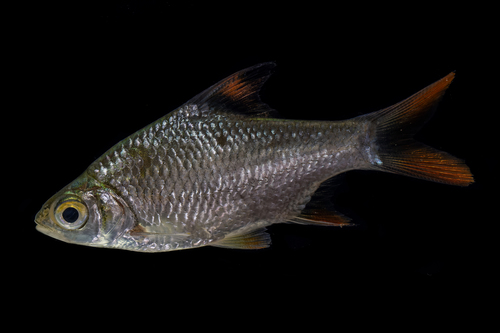
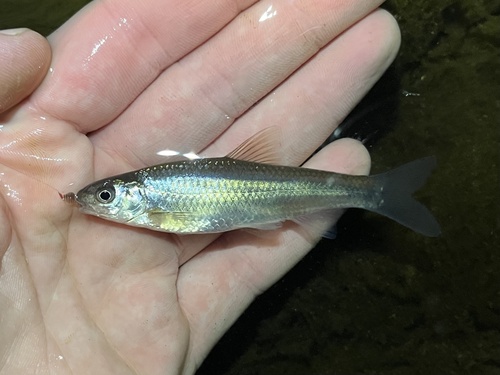
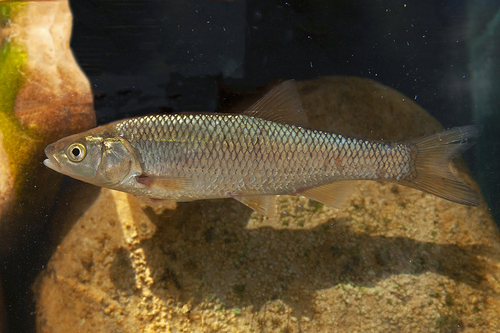
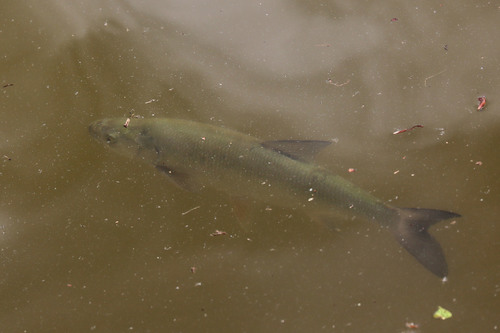
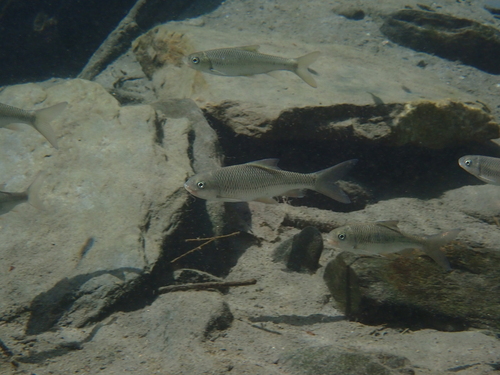
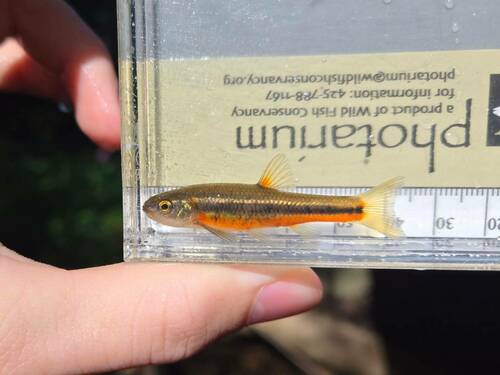
The flame chub, Hemitremia flammea, is a species of freshwater ray-finned fish in the family Leuciscidae, a group that includes daces, Eurasian minnows, and related species. This fish is found only in the United States. Historically, it occurred in Kentucky, Tennessee, Alabama, and Georgia, and its historic range broadly follows the Tennessee River from upstream of Knoxville, Tennessee, to the mouth of the Duck River. Its preferred habitat is small flowing streams, often associated with springs. Due to habitat alteration and destruction, the flame chub now has a patchy current distribution. It primarily occurs in the Tennessee River Valley from the Knoxville, Tennessee area downstream through Alabama to the mouth of the Duck River in Tennessee. Most of its population in Alabama lives in the Highland Rim or Cumberland Plateau regions. One isolated population is found in north Georgia, in the Tiger Creek watershed of Catoosa County. Around half of the flame chub's remaining range lies within Alabama, and only two of its populations there are located on public protected land; all other of its Alabama habitat is on private land. For this reason, the survival of the species and further population assessments in Alabama depend almost entirely on cooperation from private land owners. While literature often states the flame chub lives in spring-fed streams, shallow seepage waters, and springs, usually over gravel in areas with abundant aquatic vegetation, the substrate it occurs on can range from bedrock and rubble to mud, and it can also be found in low-flow areas near the banks of large streams. A study by P. W. Shute found that only 37 out of 235 recorded collection localities for the species were actual springs, even though it is often described as a spring-dwelling species. Regardless, the flame chub is still primarily found associated with spring heads, as most collection localities lie within watersheds that are fed by springs. Almost all documented records of the species come from small streams. It has been hypothesized that this species is migratory within its range: individuals may travel from their home stream to headwaters to spawn, or the species exists as metapopulations where springs act as both source populations for stream localities and as refugia. Adult flame chubs have also been observed aggregating in flooded fields and pastures to spawn. Because springs and their tributaries are fragile habitats, human expansion has caused further range fragmentation for this already narrow endemic species. As of 2014, the IUCN lists this species as Near Threatened, due to ongoing threats from introduced non-native fish species and human-caused habitat alteration. Recorded water temperatures in streams that host flame chubs range from 24 °C (75 °F) in July to 8 °C (46 °F) in February. Total dissolved solids in these streams range from 17 to 213 ppm, with pH ranging between 6.4 and 8.2. In 1990, Sossamon recorded that a flame chub population in east Tennessee was typically found associated with aquatic vegetation including swamp smartweed, small pondweed, and watercress. The flame chub feeds almost exclusively on dipteran larvae and pupae, which make up 77–100% of the contents of its digestive tract. It also occasionally eats gastropods, aquatic oligochaetes, hemipterans, and cladocerans. The presence of seeds, sand grains, and detritus in the species' gut confirms that flame chubs feed on or near the substrate. Observations of flame chubs in aquaria have recorded the species pecking at the substrate.