About Hemiscyllium ocellatum (Bonnaterre, 1788)
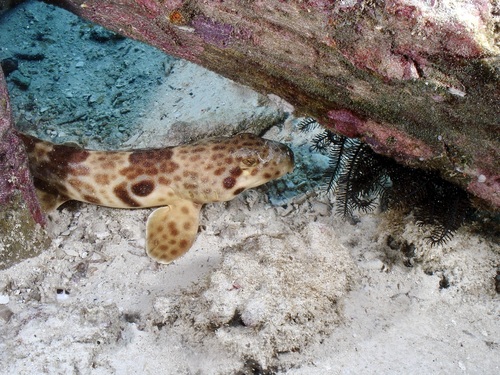
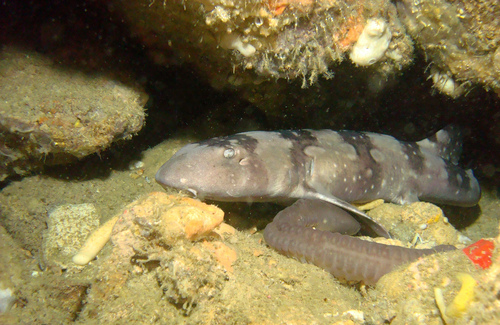
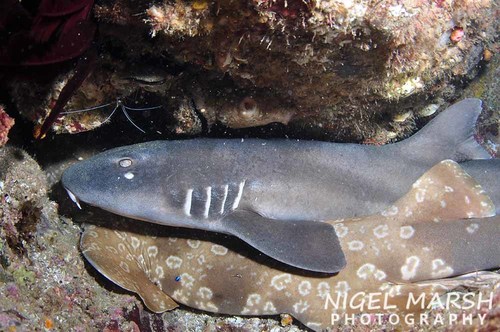
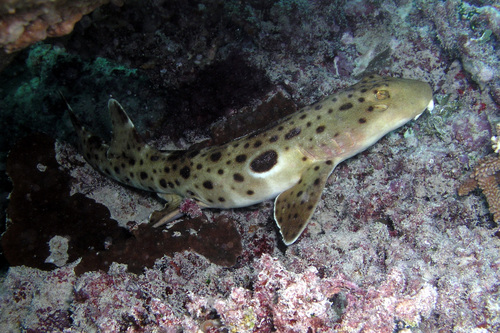
This species is scientifically named Hemiscyllium ocellatum, commonly known as the epaulette shark. The epaulette shark has an elongated body, where the slender caudal peduncle makes up over half of its total length. It has a short, rounded snout, with nostrils located almost at the snout tip, a pair of tiny barbels, and grooves that run from the nostrils to the mouth. There are 26–35 tooth rows in the upper jaw and 21–32 tooth rows in the lower jaw; its teeth are small, with broad bases and triangular cusps. The shark’s eyes are oval, elevated, and each has a large spiracle positioned below it. It has five pairs of small gill slits, with the fourth and fifth gill slits lying very close together. Its pectoral and pelvic fins are broad, rounded, and thickly muscled. The two dorsal fins are similarly sized and placed far back on the body. The anal fin is low and sits just in front of the caudal fin. The caudal fin only has an upper lobe, which has a prominent ventral notch near its tip and is angled almost horizontally relative to the shark’s body. Adult epaulette sharks are beige to brownish on their upper side, with many widely spaced brown spots and faint darker bands. A very large black spot ringed with white sits behind each pectoral fin; this pair of distinctive spots gives the shark its common name. Juveniles have alternating light and dark bands across their bodies and fins, which break up into spots as the sharks mature. Most epaulette sharks reach 70–90 cm (27.5–35.5 in) in length, and the maximum confirmed length recorded for the species is 107 cm (42 in). The epaulette shark’s native range stretches from the southern coast of New Guinea to the northern coast of Australia, reaching as far south as Sydney. A particularly large population lives in the Capricorn-Bunker Group of the Great Barrier Reef, where thousands of individuals are estimated to inhabit the reefs around Heron Island alone. The estimated population density in these reefs ranges from approximately 0.3 to 1.2 individuals per 100 square meters. There are unsubstantiated reports of this species occurring in Malaysia, Sumatra, and the Solomon Islands. Epaulette sharks inhabit shallow water up to a maximum depth of 50 m (160 ft), and are frequently found in water barely deep enough to cover their bodies. They prefer habitats including tidal pools, coral flats, and stands of staghorn coral. As an adaptation for moving through its complex reef habitat, the epaulette shark moves in a walking-like motion: it bends its body from side to side and pushes off the seabed substrate using its paddle-shaped pectoral and pelvic fins. This gait is similar to that of salamanders, and is an example of convergent evolution. While the shark is capable of swimming, it often prefers to walk along sandy or coral bottoms even when the water is deep enough for free swimming. Compared to other sharks, the cartilaginous supports of the epaulette shark’s paired fins are reduced and separated, which allows the fins to rotate and function like limbs. This locomotion method even lets the shark crawl out of water to reach isolated tidal pools. The epaulette shark’s walking gait is convergently similar to the gaits of tetrapods such as salamanders, which suggests that the movements required for walking on land may have evolved before the first terrestrial vertebrates, and may have contributed to their evolution. Epaulette sharks are mostly nocturnal and most active during low water levels. They often hide inside or underneath coral heads, and will even leave most of their body exposed as long as their head is covered. Sometimes they perch in open areas on sandy flats or on top of reefs while facing into the current; this orientation behavior is called rheotaxis, and it may improve the shark’s respiration or predator awareness. Larger fishes including other sharks prey on epaulette sharks. The shark’s coloration provides protective camouflage, and its distinctive epaulette spots are hypothesized to act as eyespots to distract or deter predators. Almost all epaulette sharks are parasitized by the praniza, the parasitic larval stage of gnathiid isopods. These larvae feed on blood, and mostly attach to the skin around the cloaca and claspers, though they can also be found inside the mouth and on the gills. These parasites cause very little damage and are not thought to negatively impact the shark’s health. Additional parasites that infect this species include a myxosporean species from the genus Kudoa, which infests the shark’s skeletal muscles; the hemogregarine protozoan Haemogregarina hemiscyllii, which infects the blood; the ostracod Sheina orri, which attaches to the gills; and the nematode Proleptus australis, which infests the stomach.