About Hemipus picatus (Sykes, 1832)
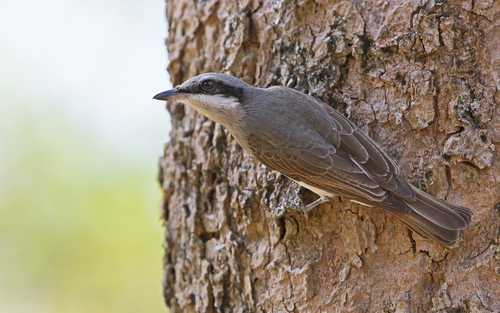
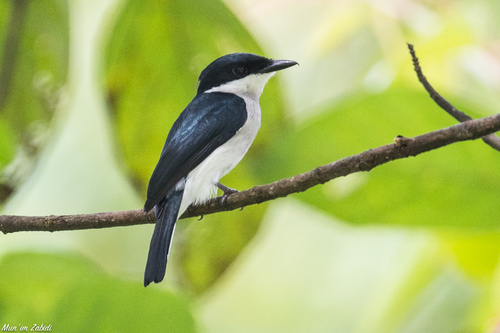
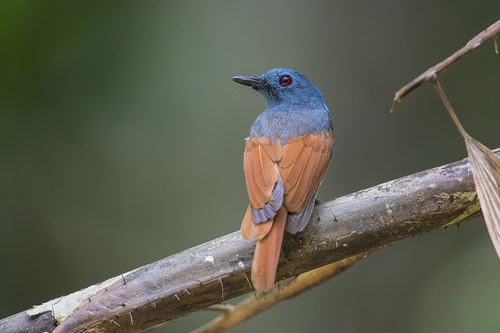
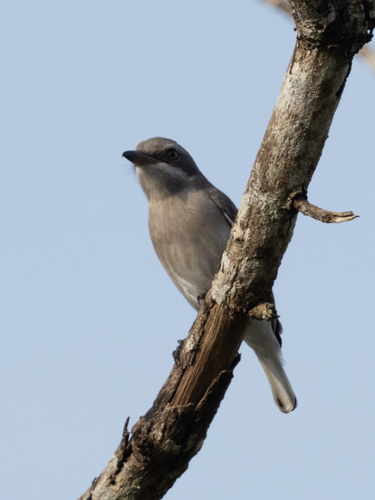
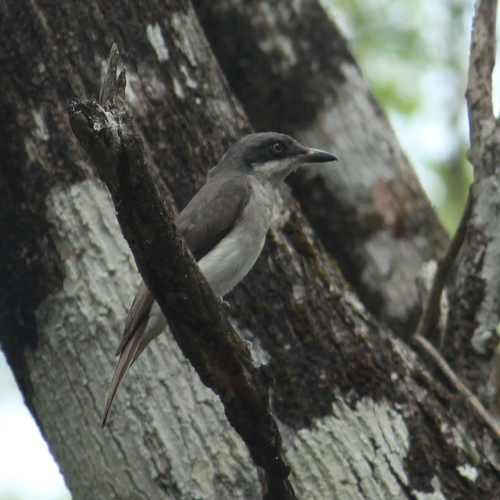
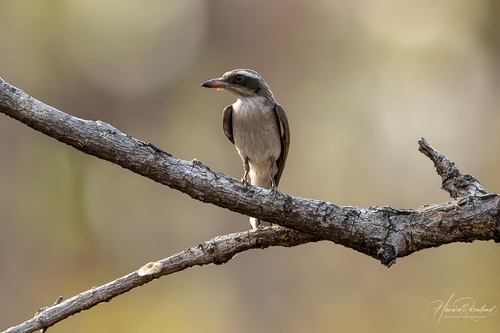
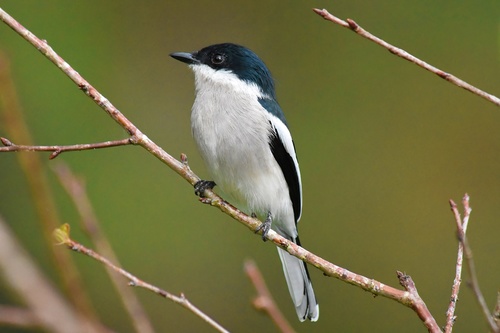
Bar-winged flycatcher-shrike (Hemipus picatus (Sykes, 1832)) has a black cap and black wings that contrast with its white body. A white slash across the wing and a white rump are distinct contrasting markings. These birds sit upright on branches, and fly around to glean insects. Their nostril is hidden by hairs, and the upper mandible of the beak has a curved tip. Males are velvety black, while females are typically greyish brown, though plumage patterns vary across geographic populations. Both males and females of the Himalayan subspecies H. p. capitalis have a brown back, with males retaining a black head. The Sri Lankan population (subspecies leggei) has no sexual dimorphism in plumage. In subspecies H. p. intermedius, only females have a brownish back. The tail is black; outer tail feathers are white, and non-central tail feathers have white tips. The species' call is a rapid, high tsit-it-it-it or a whriri-whirriri-whirriri, and sometimes a sharp chip. Male-female pairs of the Sri Lankan subspecies leggei have been recorded duetting with precision. Young birds have a broken pattern of white and grey that looks like lichens. The exact placement of this species in a systematic family is unclear, but the genus Hemipus is confirmed to be closely related to the genus Tephrodornis, and shows close affinities to African Malaconotidae. The nominate race of bar-winged flycatcher-shrike occurs mainly in the Western Ghats of India, and becomes very rare towards the Surat Dangs. It is also found in parts of central and eastern India, extending into Bangladesh. Subspecies capitalis occurs along the Himalayas from Simla east to Manipur and Chittagong in India, and extends into northern Thailand, Myanmar and Laos. Subspecies leggei, found in the hill forests of Sri Lanka (southern Western Ghats populations were included in this subspecies in older works), has indistinguishable sexes. Subspecies intermedius occurs in Southeast Asia, in Sumatra, Borneo, and parts of the Malay Peninsula. In this subspecies, the brownish grey wash on the breast of females is darker, contrasting with the white abdomen, and the back is darker brown than in other subspecies; males also have darker breasts. Other described subspecies, such as Walter Koelz's pileatus from the Lushai Hills and insulae from Sri Lanka, are not considered valid. Bar-winged flycatcher-shrikes catch insects by gleaning foliage and making aerial sallies for flushed insects. They will join feeding flocks with other small birds, including babblers, velvet-fronted nuthatch and white-eyes. They move through the forest and rarely stay in one fixed location. The nesting season is mainly February to August in Sri Lanka, and March to May in India. The nest is a neat cup; its rim is stiffened by binding cobwebs, and the interior is lined with fine grass and fibre. The outer surface of the nest cup is covered with lichens. It is placed on the horizontal surface of a dry branch, often close to the tip of a dead branch or on a leafless tree, which makes it look like a knot in the wood. The usual clutch is 2 or 3 eggs, which are pale greenish white with black and grey blotches. An adult sitting on the nest appears to be casually perched. Both males and females take turns incubating eggs. Nestling chicks stay still with their eyes closed, face the center of the nest, and hold their bills upward, which gives them the appearance of a broken branch. Some sources note that bar-winged flycatcher-shrikes are sensitive to forest degradation, but other studies note they are less sensitive and can persist even in considerably disturbed forests.