About Hemiphaga novaeseelandiae (J.F.Gmelin, 1789)
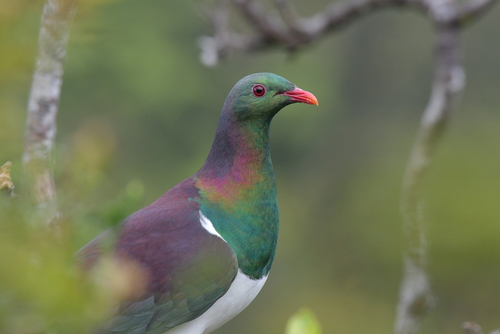
The kererū, scientific name Hemiphaga novaeseelandiae (J.F.Gmelin, 1789), is a large arboreal pigeon. It weighs 550–850 g (19–30 oz), reaches up to 50 cm (20 in) in length, and has a wingspan of around 75 cm (30 in). It follows a typical pigeon body plan, with a relatively small head, a straight soft-based bill, and loosely attached feathers. Males and females have similar plumage. The head, neck, and upper breast are dark green with gold-bronze highlights. The nape, upper back, and secondary coverts are copper-sheened purple, which lightens to a grey-green shade on the lower back, rump, and the rest of the upper surface of the wings. The tail is dark brown with green highlights and a pale edge. The breast is white, and is sharply divided from the darker parts of the bird's plumage. The undertail and underwing coverts are mainly pale grey. The bill is red with an orange tip, the feet are dark red, and the eyes are red with a pink orbital ring. Juveniles have a similar general colour pattern but are generally paler, with duller colouration on the beak, eyes, and feet, and a shorter tail. The now-extinct Norfolk Island subspecies had a chestnut mantle, more grey colour on the outer wings and rump, a dark purple tail, and white under wing and undertail coverts. Kererū produce occasional soft cooing sounds, and their wings make a characteristic "whoosh" noise during flight. Their flight pattern is also distinctive: birds often ascend slowly before making steep parabolic dives. Kererū are currently found from Northland to Stewart Island and offshore islands of New Zealand, and were historically abundant throughout the country. The species' low genetic diversity indicates that it retreated to forest refugia during Quaternary glaciation periods, then rapidly spread across the country again once the climate warmed. Kererū bones have been recovered from Raoul Island in the Kermadecs, which confirms the species once inhabited the island, though it became locally extinct there through hunting and cat predation in the late 1800s. They occupy a wide variety of habitats, including native lowland forest, scrub, countryside, and city gardens and parks. Their habitats range in altitude from coastal to montane areas. After European colonisation, kererū numbers declined significantly, mainly due to habitat loss, introduced predators, and hunting. Today, the presence of kererū at any given location within New Zealand depends on multiple factors, including forest cover, forest type, and predator density. Although they are generally sedentary, kererū can travel considerable distances within their range to find food. Most fieldwork records maximum movements of up to 25 km (16 mi). A 2011 study in Southland found that three out of four kererū tagged near Invercargill crossed Foveaux Strait to Stewart Island, and travelled up to 100 km (62 mi).