About Hemimycale columella (Bowerbank, 1874)
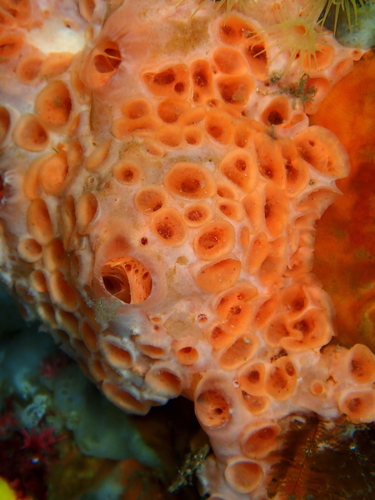
Hemimycale columella is an encrusting sponge that grows in cushion-shaped formations 10 to 30 centimeters in diameter and over 1 centimeter thick. Its color is most commonly pale orange or pink, though it may also be a brighter shade of red. The sponge's surface is covered in shallow, circular pits of varying sizes; the rims of these pits are usually lighter in color than the rest of the organism. Inside the pits are pores, which are covered by a fine mesh. Two unrelated species, Phorbus fictitus and Hymedesmia pauperatus, share similar characteristics with Hemimycale columella, but differ slightly in color. Additionally, the pits of P. fictitus are more regular in shape than those of H. columella. Ecologically, this species grows attached to bedrock and boulders in silt-free littoral habitats around the British Isles and in the Mediterranean Sea. Hemimycale columella is hermaphroditic and produces live offspring. New generations typically start developing when water temperatures rise over the summer, with embryo development taking place from approximately September to October. During this period, embryos develop at different rates, so multiple developmental stages of embryos can be found within a single parent organism. Once the embryos develop into larvae, the young are dispersed when water temperatures drop rapidly in late October.

