About Hemileuca maia Drury, 1773
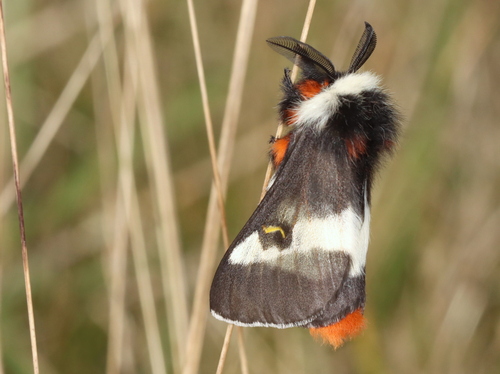
Mature adult Hemileuca maia (buck moths) are dark gray to almost black, with a distinct white band crossing each wing and a unique eyespot located on the band. Adult moths have a wingspan of roughly 2 to 3 inches, and a body length of approximately 6 cm, though males are consistently smaller than females. Both sexes have three distinct body segments: head, thorax, and abdomen. All three segments are entirely black in females, while males have all black segments except the abdomen, which is rusty red, making it easy to tell males and females apart. All buck moths have black legs with small red cuffs around the section of each leg that connects to the body. Young buck moth caterpillars are solid black, with pale brown spiracles (small respiratory openings) that have black edges. Older caterpillars are noticeably lighter than young individuals, and some even appear white. The most prominent feature of Hemileuca maia caterpillars is their defensive spines, which they use to protect themselves from predators and in dangerous situations. Spines cover the entire body of both young and older caterpillars, but the spines along the top of the body are longer, more abundant, and arranged in clear rows. Fully grown caterpillars can reach 2.5 inches in length. Once mature, they crawl down to the ground to prepare for metamorphosis into adult buck moths. Buck moths are most abundant in large oak forest habitats, ranging across the eastern United States from the northern parts of the region south to the Florida Gulf Coast. Some individuals have been found as far west as Wisconsin and Texas, but the species is predominantly found along the U.S. East Coast. This moth prefers large, intact oak forests over the fragmented forests common in the northeastern U.S. Since buck moth habitats are centered on oak forests, the species faces an increased risk of habitat loss from deforestation and fire suppression methods that use chemicals and preventive burning. As deforestation has reduced their original habitat, buck moths have moved into more unusual locations such as urban cities as they search for new oak trees to inhabit. The species relies heavily on oak forest habitat for reproduction: female moths lay and store their eggs on oak twigs until they hatch. In more northern parts of their range, buck moths live in scrub oak stands, which are a key food source for their caterpillars. Buck moths are most active during the summer, but they also become active during warm fall periods when females search for mates. Oaks serve as both the species' main habitat and main food source, as buck moths prefer to feed on oak species. Adult Hemileuca maia produce one generation per year. The life cycle begins in fall, usually between October and November, when adult males fly to find and mate with females. Males are stronger fliers, as finding a mate is their only primary task. Females lay around 150 eggs per generation, depositing them in a tight ring around an oak host branch. The eggs overwinter, remaining in place through the entire winter until spring, when conditions become favorable for hatching. Hemileuca maia larvae hatch in groups starting in early May, when new oak growth emerges. The larvae go through six instar stages—molting periods during which they shed old exoskeleton material as they mature in preparation for pupation, becoming more independent with each stage. Once caterpillars reach their final instar, they pupate either in forest floor debris or by weaving a cocoon; weaving a cocoon is the less common of the two options. Buck moths can remain in pupation for up to two years while waiting to emerge as adult moths. When adults emerge, their only purpose is to find a mate and reproduce for the next generation. Adult buck moths lack functional mouthparts, so they cannot feed. After emergence and reproduction, the life cycle restarts for the next generation.