About Hemileuca lucina H.Edwards, 1887
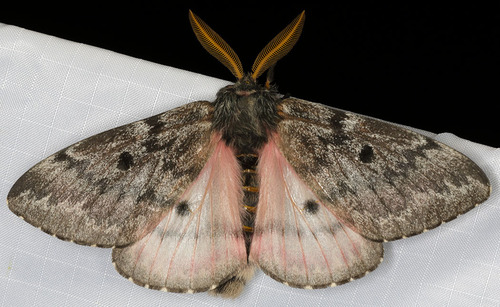
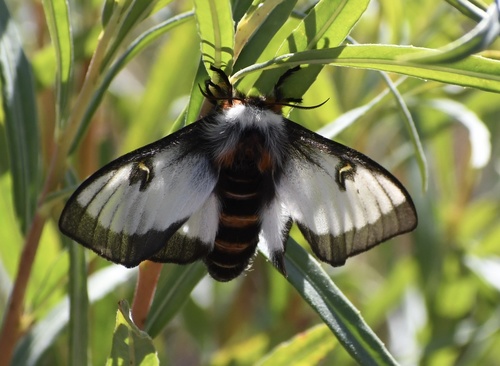
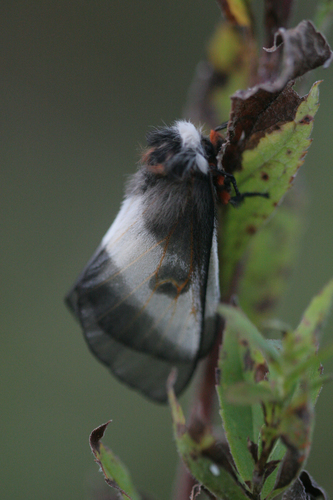
Hemileuca lucina, also known as the New England buck moth, was first described by H. Edwards in 1887. Adult females of this species are generally larger than adult males, and the two sexes also differ in their abdominal tufts. The forewing band width of females ranges from 30 to 34 mm, while male forewing band width ranges from 23 to 28 mm. Individual adult moths of this species vary in wingspan, wing translucence, and band width. In general, smaller moths with more translucent wings are found in central Maine, while larger, darker moths are found in southern Massachusetts. This observation indicates that the species' phenotype varies, and variation may depend on multiple factors including location and temperature. Both larvae and adults of Hemileuca lucina are often mistaken for Hemileuca maia and Hemileuca nevadensis. The early larval stages of Hemileuca maia are very similar to Hemileuca lucina larvae, and late-stage larvae of the two species are almost identical. Compared to H. maia larvae, Hemileuca lucina larvae are generally smaller, and have a sharply defined white stripe above the feet that is either faint or absent in H. maia larvae. For adult moths, H. maia is darker than H. lucina, and has narrower white forewing bands marked with circular spots. In contrast, adult H. nevadensis have wider white forewing bands that are more convex than those of H. lucina adults, and H. nevadensis wings are generally more opaque. As the common name New England buck moth suggests, this species occurs in the New England states of Maine, New Hampshire, and Massachusetts, where it inhabits wet meadows. The species has a very localized distribution, with very few individuals recorded outside of this region. Its population density often experiences large fluctuations driven by changes to its local environment. The full distribution of this species is not yet fully understood, because its habitat range is more restricted than the range of its host plants. Early records report that Hemileuca lucina larvae use broadleaf spirea and oaks as host plants, but recent findings indicate that larvae mainly feed on meadowsweet (Spiraea latifolia). The age of the consumed shrub influences larval growth: third instar larvae prefer new leaves, and show increased growth after eating new leaves compared to mature leaves. Early instar larvae feed primarily on meadowsweet, while later instar larvae have also been observed feeding on blackberry (Rubus species), cinquefoil (Potentilla species), and black cherry. Adult female Hemileuca lucina are not known to feed, but the general feeding habits of adult moths of this species require further study.