About Hemileuca eglanterina Boisduval, 1852
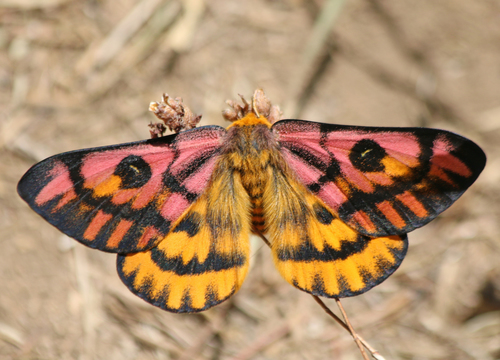
The sheep moth, also called the common sheep moth (Hemileuca eglanterina), belongs to the silk moth family Saturniidae and is native to western North America. In California, its range lies west of the Sierran crest and the mountains of Southern California, extending close to the coast. This moth is active during the day and emerges in summer. Its larvae feed on plants from three genera: Ceanothus, Rhamnus (which includes coffeeberry), and Rosa. Nuttall's sheep moth and one other related species are similar in appearance; these similar species live in sagebrush areas east of the Sierra Nevada. This species was first formally described by Jean Baptiste Boisduval in 1852. The sheep moth has a wingspan of 5.5 to 8.5 centimeters and a relatively slender body. Its forewings are pink, with a yellow streak running through the middle, while its hindwings are yellowish with variable black markings. An all-black color morph of this species occurs near Mount Shasta. The larvae are black with branched yellowish spines, an orange-brown head, and their spines turn orange as they develop through later growth stages.