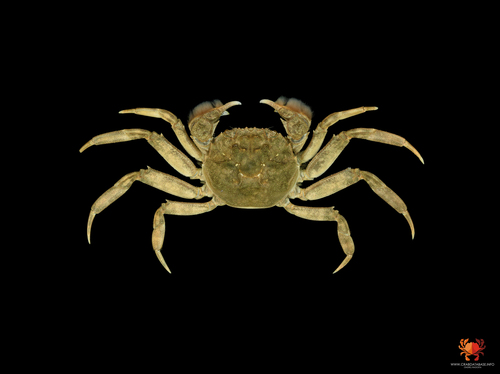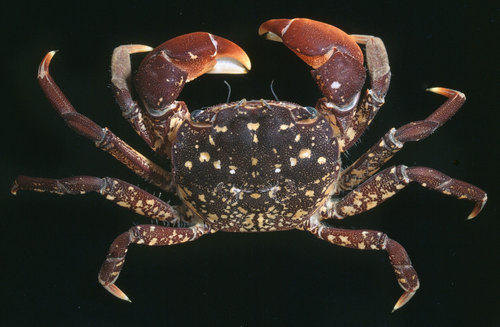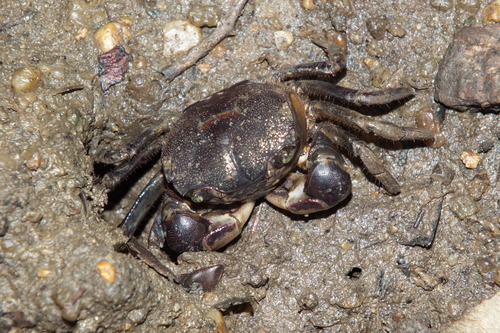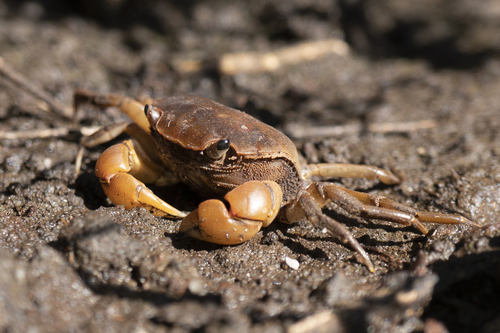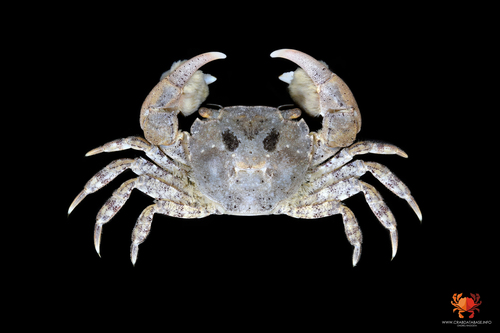
About Hemigrapsus takanoi Asakura & Watanabe, 2005
Before 2005, the name Hemigrapsus penicillatus was used to refer to a group of crabs that are now recognized as two separate species. Hemigrapsus penicillatus in the strict sense has smaller patches of setae, or bristles, on the chelae (claws) of male individuals. By contrast, Hemigrapsus takanoi has larger setal patches and larger colored spots on its exoskeleton. This species can display a range of colors, including orange-brown, maroon, or green, with striped legs and spotted claws. Male H. takanoi, also called brush-clawed shore crabs, have a patch of light brown or yellow bristles (setae) on their chelae, or pincers. The carapace of this species typically reaches a width of about 2.5 centimetres (1.0 in), and features three spines. Before maturing into juvenile crabs, H. takanoi larvae spend almost one month floating freely in the ocean, which allows them to access new food sources and colonize new habitats. Hemigrapsus takanoi is native to Japan, Korea, Russia and China, though the full boundaries of its native distribution remain unclear. Hemigrapsus takanoi has been introduced to European coasts through human activity, and has become an invasive species in this region. Though introduced populations were originally reported as Hemigrapsus penicillatus, the species was later split into two, and only H. takanoi occurs on European coasts, not H. penicillatus. It is thought to have arrived in Europe in 1993, and was first discovered in La Rochelle, France, in 1994. A contemporary study of hull-fouling organisms on ships in Hamburg Dockyard and Bremerhaven found six specimens of H. takanoi on the car-carrying ship SPICA, which traveled between the Asian ports of Tokyo, Osaka, Kobe and Pusan, and Europe. The ship passed the French coast in 1993, and introduction is thought to have likely occurred when crabs fell from the SPICA’s hull during this passage. By 1997, the European range of H. takanoi extended from Fromentine in France, adjacent to Île de Noirmoutier, to Laredo, Spain, covering 700 kilometres (430 mi) of coastline around the Bay of Biscay. By 1999, the species had reached Le Havre on the English Channel, and by 2005 it had reached the French Opal Coast at the entrance to the North Sea. Based on conditions in its native climate, a 1999 prediction stated H. takanoi would spread across much of the North Sea and the western parts of the Baltic Sea. This prediction was later confirmed: the species was first documented in the Dutch Wadden Sea in 2004, in the German Wadden Sea in 2007, and in the Danish Wadden Sea in 2011. Its northward spread along the western coast of Jutland has continued, and it is now also present in the Limfjord and Oslofjord in Norway. It was first confirmed to be present in Great Britain in 2014, when it was discovered on the southeastern coast at the Medway Estuary. The first record of H. takanoi in the Baltic region came in 2014, when individuals were caught in Germany’s Kiel Fjord; they likely arrived via the many ships that pass through the Kiel Canal, which connects the North Sea and Baltic Sea regions. In 2018, the species was first recorded in Denmark's South Funen Archipelago. In 2023, two adult males were recorded in Poland’s Gdańsk Bay, but establishment in the Baltic Proper may be limited by low salinity that impairs larval development.