About Hemigrapsus sexdentatus (H.Milne Edwards, 1837)
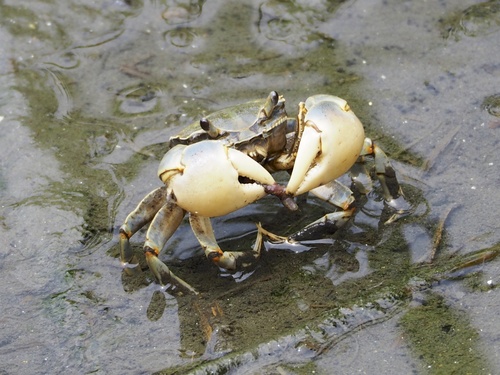
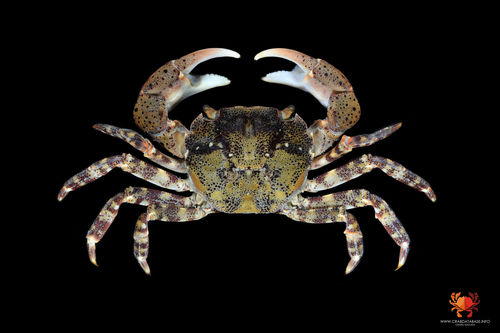
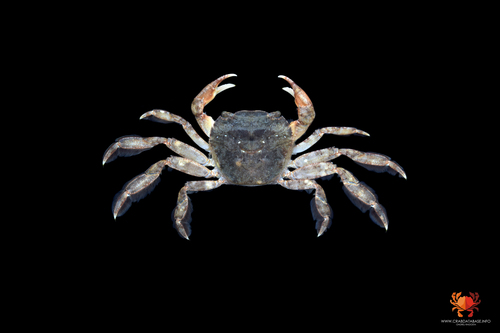
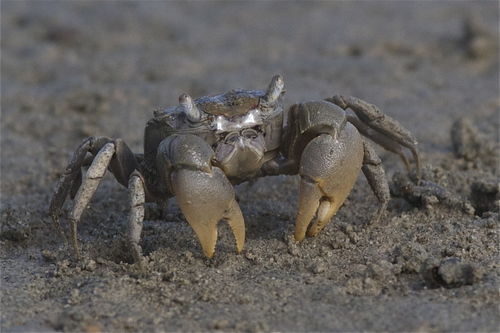
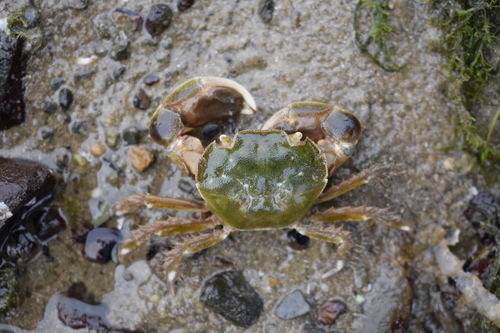
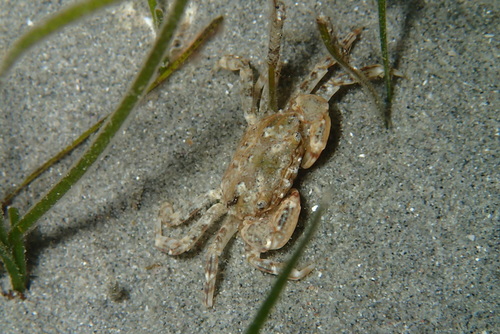
Hemigrapsus sexdentatus belongs to phylum Arthropoda and subphylum Crustacea, sharing the subphylum’s typical characteristics while having distinct unique traits. Females of this species grow to a carapace width of around 45 millimeters (1.8 inches), while males reach up to 55 millimeters (2.2 inches). This crab has a distinctive square carapace (shell) with two teeth on each side. Its chelae (claws) are usually short, though males may have large claws. The crabs are primarily grey, with two main forms of patch marking that differ in both color and size: pale and dark. The pale form has large pale to dark red patches, while the dark form has smaller dark purple to blue-black patches. For both forms, the dorsal carapace is darker toward the front, fading and growing sparser toward the back, and the underside of the crab is white. The legs and claws are white, with red to purple pigmentation matching the intensity and color of the carapace patches. H. sexdentatus is a gonochoristic species, with separate male and female individuals. Males can be distinguished by visible bulges of white muscle that protrude from the nipper joint, which females do not have. Females carry eggs during the southern hemisphere winter, from April to September, and can carry up to 26,000 eggs with an average size of 0.35 mm. Multiple studies have examined the reproductive behavior of H. sexdentatus. One laboratory study of female receptivity and male-male competition found that male-male competition is the dominant factor shaping pair formation, while female receptivity changes depending on the presence of males. This competition affects reproductive outcomes: larger males breed more often, and can take a female mate away from a smaller male crab. To a lesser degree, female control of receptivity in response to male presence can also influence the result of sexual selection during the breeding period. Research has also found that H. sexdentatus embryos begin developing osmoregulatory functions from the earliest embryonic stages. H. sexdentatus inhabits the rocky intertidal shore zone of the New Zealand coast. It can be found along the full length of New Zealand, but is far more abundant on southern shores, because the species O. truncatus replaces it in northern areas. It lives on relatively sheltered, rocky and muddy shores from the high tide level down to around the mid-tide level. It feeds on sea snails, using its chelae to break through their hard shells, and also eats drift algae. H. sexdentatus has relatively few fish predators, but has been found in the stomachs of rig, red cod and sea perch. Cephalopods and zoea also prey on this crab.