About Hemigrapsus sanguineus (De Haan, 1835)
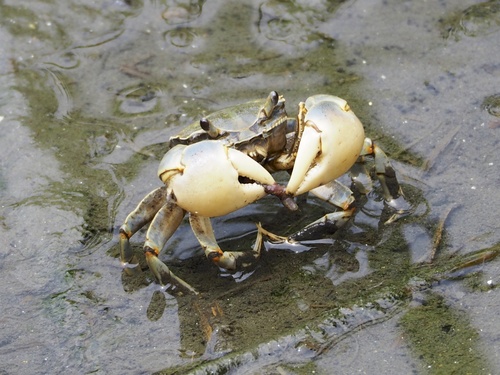
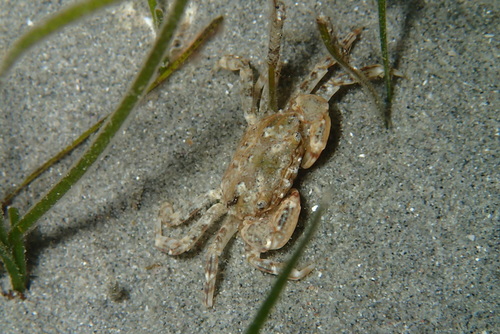
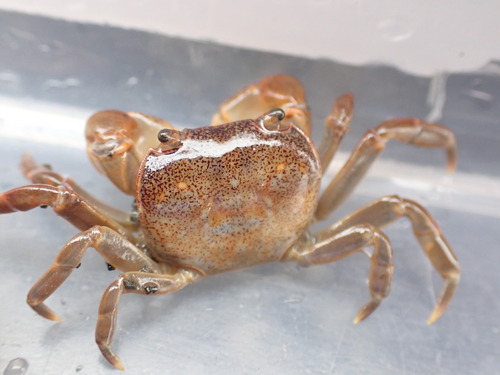
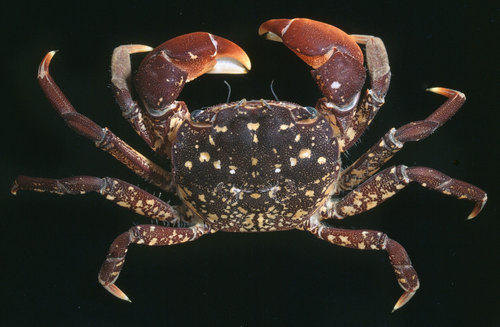
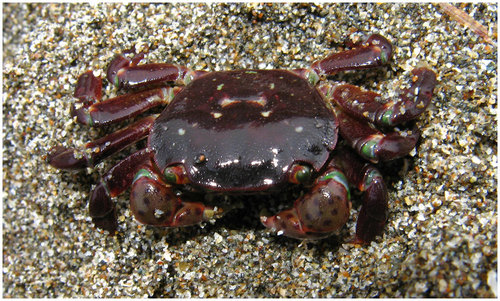
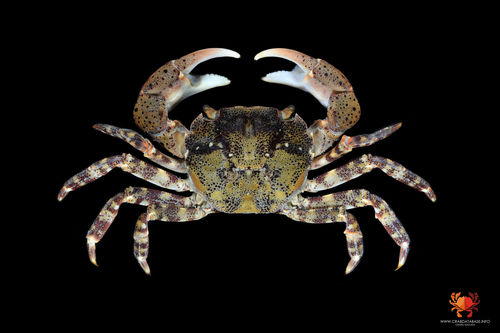
Hemigrapsus sanguineus (De Haan, 1835) has a squarish carapace, most often 35–42 mm wide, with a maximum recorded width of 50 mm (2 inches). Three teeth or spines run along each forward side of the carapace. Its pereiopods feature alternating light and dark bands, and males have a bulb-like structure at the base of the movable finger on their claws. This species is an opportunistic omnivore that tends to favor animal prey over algae. As the density of H. sanguineus increases in an invaded area, the breadth of its diet expands, which suggests competition alters its food selection. Currently, there is no mitigation strategy for this crab. A natural enemy specific to H. sanguineus is Sacculina polygenea, a parasite that attacks adult shore crabs. H. sanguineus is also classified as euryhaline (tolerates a wide range of salinities) and eurythermic (tolerates a wide range of temperatures). Females can produce up to 50,000 eggs per brood, and 3 to 4 broods per year. Eggs hatch into zoea larvae, which develop through four additional zoea stages and one megalopa stage over 16 to 25 days. Eggs typically hatch in late summer or fall. After hatching, juvenile crabs molt through five stages to become megalopae, a process that takes approximately one month. Once they reach the megalopa stage, the crabs settle and metamorphize into mature benthic adults. Larvae are planktonic, so they can be transported long distances while developing into adults. H. sanguineus typically inhabits rocky areas, such as the spaces between boulders on rocky shores, and it also occupies many artificial structures and oyster reefs. It can tolerate alternative habitats including salt marshes. The native distribution of H. sanguineus is coastal waters of the northwestern Pacific Ocean, ranging from Peter the Great Bay in southern Russia to Hong Kong. The first recorded sighting of this crab outside its native range was in 1988 at Townsends Inlet, Cape May County, New Jersey (between Avalon and Sea Isle City) in the United States. Its larvae are thought to have been transported via the fouled hulls of yachts. From the 1990s onward, it spread as an invasive species through similar vectors including ballast water, and has become increasingly common. Its introduced range along the US Atlantic coast now extends from eastern Maine (Great Wass Island) to North Carolina. In 1999, H. sanguineus was first reported in European waters, after being discovered at Le Havre, France, and in the Oosterschelde estuary, the Netherlands. It has since been found along a long stretch of the continental coast of the English Channel, from the Cotentin Peninsula to the Dover Strait. Its range has extended east and north along the North Sea coastline, including northwestern Germany and Western Jutland, Denmark. In the United Kingdom, it has been recorded from Guernsey, Jersey, Kent, and south Wales. The species was first reported in Sweden in 2012. In 2019, Swedish authorities reported that a private individual collected over 50 specimens of the crab near the island of Orust in the Skagerrak–Kattegat region. The specimens were very small, indicating the species is now reproducing in Swedish waters. A couple of months later, it was first reported from the Øresund, the narrow strait between the Danish Island of Zealand and the Swedish province of Scania. There is only one recorded occurrence of H. sanguineus in the Mediterranean Sea: a 2003 sighting in the northern Adriatic Sea. A single specimen was also collected from the Romanian coast of the Black Sea, near Constanța, in 2008. In 2020, positive identification of the species was confirmed in Port Phillip Bay, Victoria, Australia. Since then, there have been many verified sightings, and H. sanguineus is now classified as an established species in Victoria, Australia.