About Hemigrapsus oregonensis (Dana, 1851)
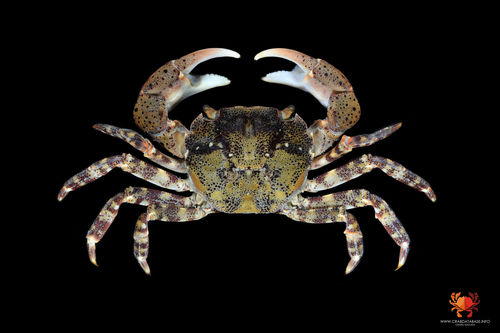
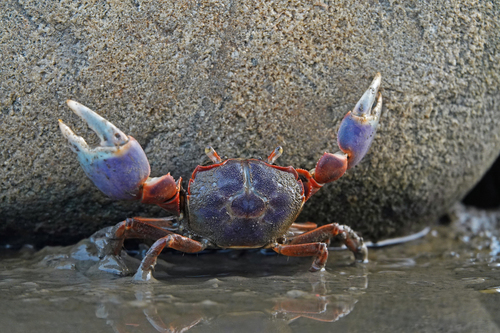
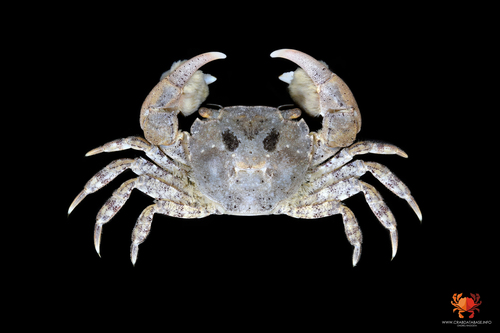
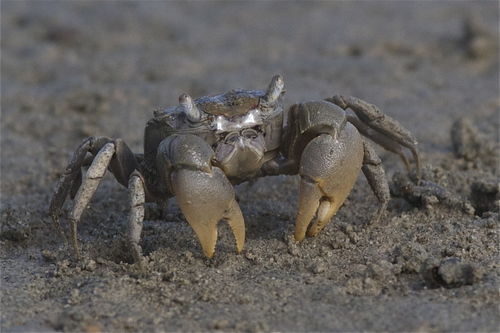
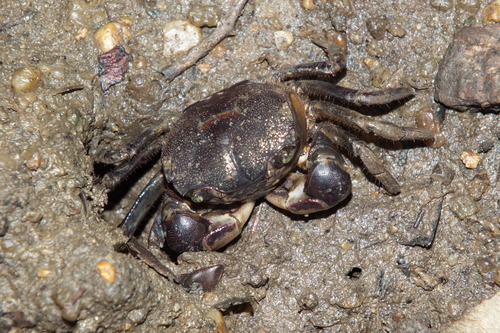
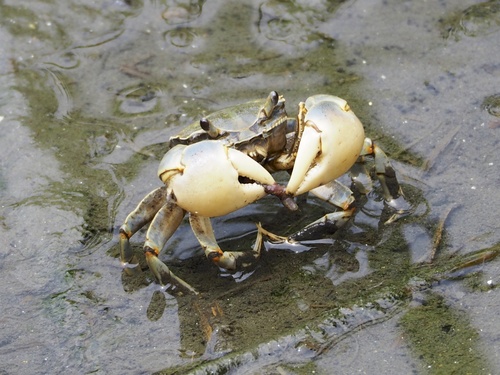
Hemigrapsus oregonensis is an intertidal crab species with wide-set eyes and no rostrum. Contrary to what its common name may suggest, its body color can vary widely. Most often, its rectangular carapace is deep red or brown with light green spots, but it may also be grey-green, yellow-green, pale green, or white with small blue or black spots; its legs are typically lighter and marked with similar spots. The hind region of the carapace has no transverse ridges, and features three teeth between the orbit and the lateral angle. On average, female crabs have a carapace width of 29.1 mm, while male crabs have an average carapace width of 34.7 mm. Males and females can also be told apart by abdomen shape: females have an oval abdomen, and males have a slightly pointed abdomen. All legs are covered in setae, and the claw-bearing legs (chelipeds) have white or yellow tips with no purple spots. The merus segment of the hind legs is unflattened. The entire Hemigrapsus genus is restricted to the Pacific Ocean, with two exceptions: Hemigrapsus affinis, which lives along the Atlantic coasts of South America from Cape San Roque in Rio Grande do Norte state, Brazil to the Gulf of San Matías in Patagonia, Argentina; and introduced populations of Hemigrapsus sanguineus, which is native to East Asia and has been introduced to the Atlantic coast of the United States from Portland, Maine to North Carolina, as well as to the English Channel and North Sea. Hemigrapsus oregonensis most commonly lives under rocks in intertidal zones, but can also be found along shorelines, mud flats, algal mats, eelgrass beds, and the tidal estuary mouths of large rivers. It favors habitats with varied plant matter, fine sediment, and slow, protected currents. Its native range along the Pacific coast of North America extends from Resurrection Bay in Alaska to Bahía de Todos Santos in Baja California, with dense populations in San Francisco Bay, the coasts of Oregon and Washington in the United States, and coastal British Columbia including Vancouver Island in Canada. The diet of Hemigrapsus oregonensis is made up primarily of diatoms and green algae, but it will occasionally eat animal matter when it is available. It acts as a scavenger, preys on small invertebrates, and can also filter feed using its maxillepeds. Hemigrapsus oregonensis is preyed on by shorebirds, a species of red ribbon worm that targets its eggs, and the European green crab Carcinus maenas — a non-native littoral crab listed as one of the world's worst invasive species. Breeding activity in Hemigrapsus oregonensis peaks in March and is lowest in October. Females carry eggs from February to July, and hatching takes place from May to July. In rare cases, a second breeding period occurs in August, with hatching in September. A female can carry between 100 and 11,000 eggs per ovulation season. After fertilization, unhatched eggs develop through a pre-zoeal stage. Once hatched, larvae pass through five zoeal stages as plankton, then metamorphose into fully grown adults after 8 to 13 weeks. The speed of development from egg to adult depends on water salinity, water temperature, and the availability and quality of food, and these same factors can also affect overall population size.