About Hemigrapsus nudus (Dana, 1851)
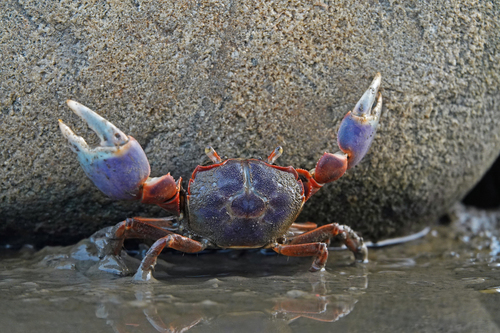
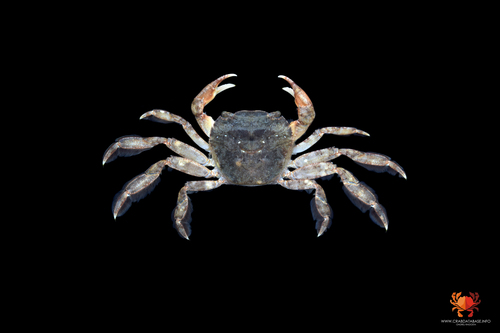
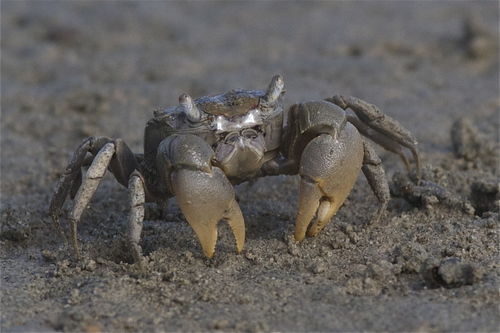
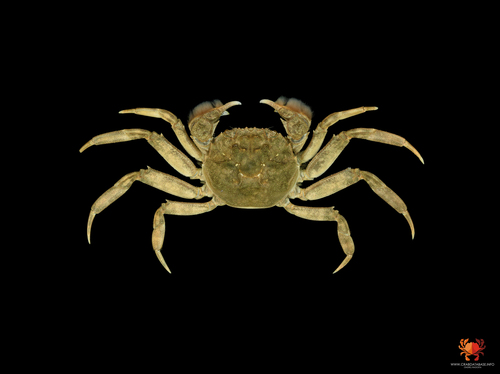
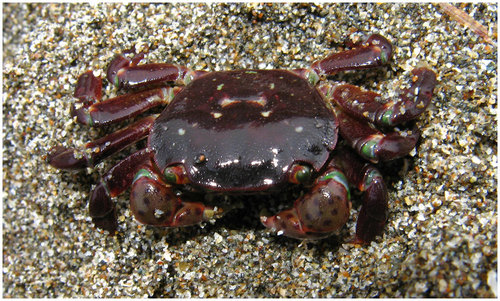
The purple shore crab, scientifically named Hemigrapsus nudus (Dana, 1851), has a body divided into two main parts: the cephalothorax and the abdomen. It is a small crab, reaching approximately 4.0–5.6 centimetres (1.6–2.2 in) in width and around 4.8 centimetres (1.9 in) in length. Beneath the thorax, five pairs of thoracic appendages and three pairs of maxillipeds fold ventrally, and its eyestalks angle outward. The mouth is formed from six pairs of appendages: one pair of mandibles sits on either side of the mouth, with two pairs of maxillae and three pairs of maxillipeds attaching posteriorly to the mouth and covering the mandibles. The dorsal shell, called the carapace, is flat, smooth, and roughly square-shaped. Its antero-lateral margins are rounded, and the carapace has no transverse lines. The carapace is usually dark purple, but may also be olive green or red, with white or cream markings. Leg color matches the carapace, but the white-tipped claws (chelipeds) are lighter in color with purple or red spots. These spots distinguish H. nudus from the similar-looking lined shore crab, Pachygrapsus crassipes, which lacks spots on its chelipeds. Additionally, the purple shore crab is generally less aggressive and slower-moving than members of the genus Pachygrapsus. Fully white and yellow-colored specimens are uncommon, but have been recorded, and this color variation has been observed across the Hemigrapsus genus. The chelipeds are smooth, equal in size, and curve inward. The legs of H. nudus lack setae, which is a feature that separates it from the otherwise similar H. oregonensis and P. crassipes. Hemigrapsus nudus shows sexual dimorphism, with females generally smaller than males. Male carapaces reach up to 2.2 inches (5.6 cm) in width, while female carapaces only grow to 1.3 inches (3.3 cm). Males have a narrow, triangular abdomen that leaves the sternum exposed, while females have a wide, flap-like abdomen that fully covers the sternum. Males have a patch of fine, long hair covering the center of their chelipeds, and this hair is mostly absent in females. The purple shore crab is most often found sheltering under rocks and in seaweed in the intertidal and subtidal regions along the western coast of North America. Its distribution range extends from Alaska to Baja California, Mexico, but it is uncommon south of Morro Bay in central California. H. nudus strongly prefers semi-protected and protected rocky coasts and bays, and is commonly found in tide pools, swift water, and under large boulders. Less frequently, H. nudus can be found under driftwood or in salt marshes. Despite growing anthropogenic plastic waste pollution in intertidal zones, H. nudus generally avoids shelters made of plastic, glass, and styrofoam when possible, and prefers natural shelters. It has been observed sheltering on acrylic surfaces, however. Unlike other members of the Hemigrapsus genus, the purple shore crab does not live in burrows. H. nudus can tolerate temperatures up to 33.6 °C (92.5 °F) but prefers colder environments. It generally avoids temperatures above 26.9 °C (80.4 °F) and strongly favors water temperatures of 17 °C (63 °F). Hemigrapsus nudus begins mating between December and January. Its mating process is very similar to that of Pachygrapsus species, except that Pachygrapsus breeds in summer rather than winter. During mating, a male holds the female by her chelipeds and guides her with his walking legs. The male uses his swimming legs (first pleopods) to transfer sperm to the female. Females become gravid (egg-bearing) between January and mid-July, most commonly in April. Samples collected from Puget Sound, Washington show that around 70% of females carry fertilized eggs by late January, and 99% are gravid by April. Females lay between 400 and 36,000 eggs per year, and second broods are rarely observed. Embryonic crabs start at 380 μm in size and grow to 450 μm before hatching. Hatching usually occurs between May and July, and is heavily dependent on water temperature. Broods in Monterey Bay, California have been observed hatching between October and May; broods in British Columbia, Canada hatch between April and May; and broods at Friday Harbor, Washington hatch in July. After hatching, crabs go through five zoeal stages and one megalopa (post-larval) stage before reaching the juvenile stage. First zoeal stage larval H. nudus have lateral projections along their second and third abdominal segments. First stage zoea are planktotrophic, with four spines and compound eyes. The rostrum and distal spines are equal in length, while the two dorsal spines are shorter. The exospine measures 1.2 millimetres (0.047 in) in length. H. nudus zoea differ from H. oregonensis and P. crassipes zoea in body and eye size. Zoea molt when transitioning to the next developmental stage. Juvenile H. nudus have a shallow depression along the frontal carapace, and their spines are generally rounded. Their eyes are larger, and their dactyls are short and flat. Male and female abdomens are identical at this stage. After the juvenile stage, growth continues through molting. Pre-molting involves the epidermis separating from the cuticle, alongside increased epidermal cell replication. Post-molt crabs have a soft shell that gradually hardens, and molting also allows for the regeneration of previously amputated limbs.