About Hemignathus wilsoni (Rothschild, 1893)
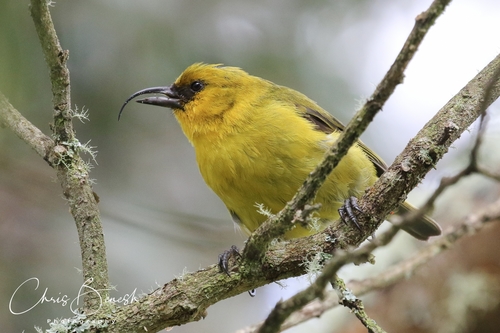
The ʻakiapōlāʻau (pronounced ah-kee-ah-POH-LAH-OW), with the scientific name Hemignathus wilsoni, is a species of Hawaiian honeycreeper endemic to the island of Hawaii. Its natural habitats are dry and montane moist forests, and it is the only bird species on the island that fills the woodpecker ecological niche. This bird measures 5.5 inches (14 cm) in length, and has an unusually curved beak, making it a specialized feeder. The ʻakiapōlāʻau is a stocky bird with whitish underparts and tail, black legs, a yellow chest, an orange-tinged head, a black face mask, a black bill, and grey-black wings. The male’s song is either a loud, short pit-er-ieu or a rapid warba-warba. Its varied calls include an upslurred whistle, a short cheedle-ee warble, and a short sweet call. After the Kauai nukupuʻu disappeared in the 1900s and the Maui nukupuʻu disappeared in the 1990s, both of which are now feared extinct, the ʻakiapōlāʻau may be the last surviving member of its genus. It is the only member of the subgenus Heterorhynchus, a group with woodpecker-like feeding habits that feeds exclusively on insects. This differs from the now-extinct nukupuʻu, which both ate insects and fed on nectar like hummingbirds. The ʻakiapōlāʻau lives mainly in old-growth mesic and wet forests in Kaʻū, Hilo District, and Hamakua. Koa (Acacia koa) and ʻōhiʻa lehua (Metrosideros polymorpha) are the dominant canopy tree species in its habitat. Disease-carrying mosquitoes have restricted its range to elevations between 1,300 and 2,100 metres (4,300 and 6,900 ft). It once lived in māmane (Sophora chrysophylla) –naio (Myoporum sandwicense) dry forests at elevations of 1,900 to 2,900 metres (6,200 to 9,500 ft) on Mauna Kea, but this local population was wiped out in 2002.