About Hemiglyphidodon plagiometopon (Bleeker, 1852)
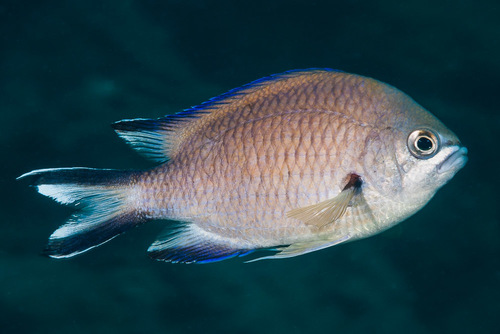
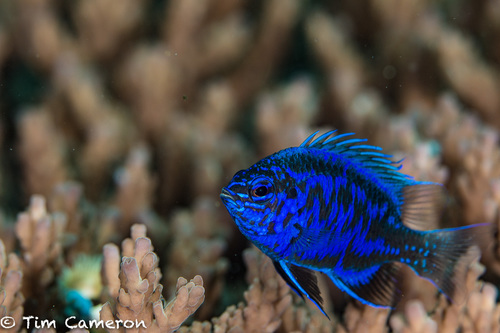
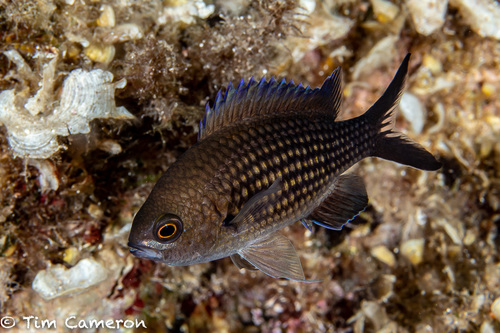
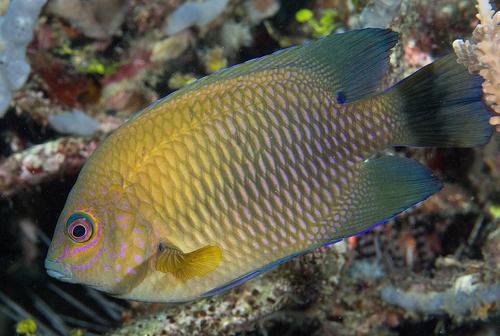
Hemiglyphidodon plagiometopon, commonly known as the lagoon damselfish, is a large brown species of damselfish. Adult individuals typically have a pale russet-colored head, and their body color gradually darkens toward the tail. Pinkish markings are present on the operculum, and sometimes a yellow eyering is the only distinct marking this species displays. Juvenile lagoon damselfish have dark blue to brownish coloration on the head and front portion of the body, with yellow coloring toward the tail and on the underside. Juveniles also have a large iridescent blue eyespot on the dorsal fin, plus blue bands and spots on the body near the head. This species reaches a maximum total length of 18 centimetres (7.1 in).
The lagoon damselfish is distributed from the eastern Indian Ocean, starting at Thailand and extending through Indonesia, the Philippines, and the Timor Sea, into the western Pacific Ocean. In the western Pacific, its range extends south to Australia, north to China, and east to the Solomon Islands.
This fish inhabits sheltered reefs and lagoons, and is most often found in areas of high turbidity with silty substrate at the base of branching corals, occurring at depths between 1 and 20 metres (3 to 66 ft). It is a detritivore, and has up to three times as many gill rakers as other damselfish species, an adaptation that allows it to feed on fine detritus. Lagoon damselfish are territorial, and defend patches of algae-covered reef. While feeding primarily on detritus, they also consume small amounts of algae and invertebrates.
During breeding, this species forms pairs. The breeding pair clears an area to create a nest, then engages in a mating dance that involves fast swimming and fin movements. When mating, males frequently darken in color and may develop white blotches. Eggs are laid at dawn; the eggs are demersal and adhere to the substrate, where the male guards and aerates them.