About Hemideina ricta Hutton, 1896
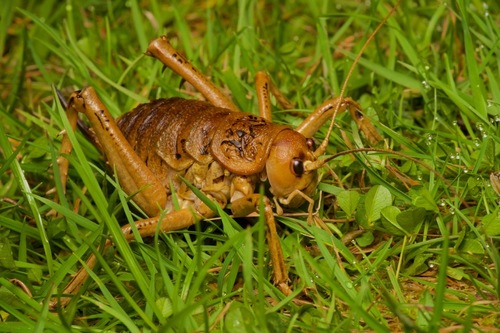
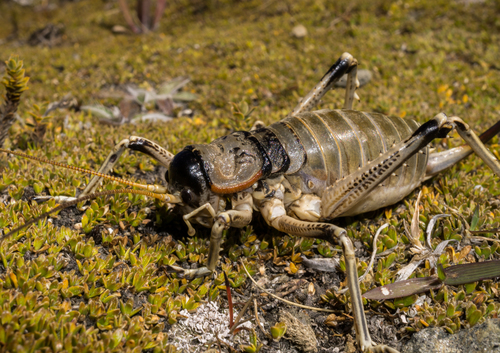
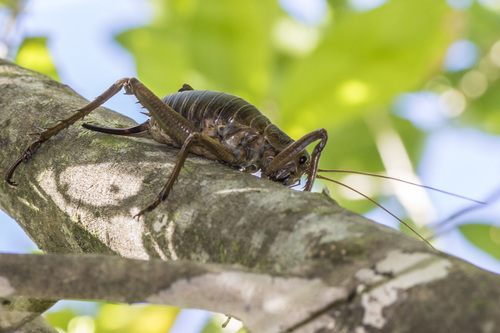
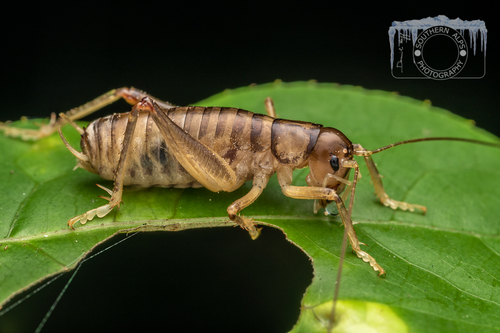
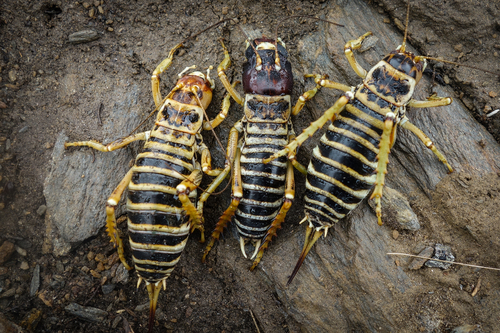
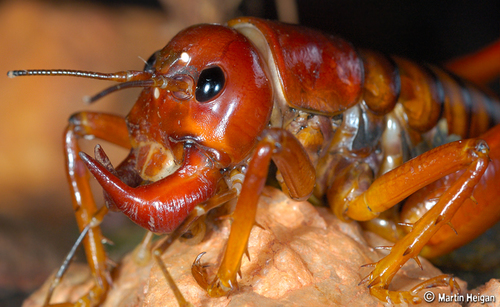
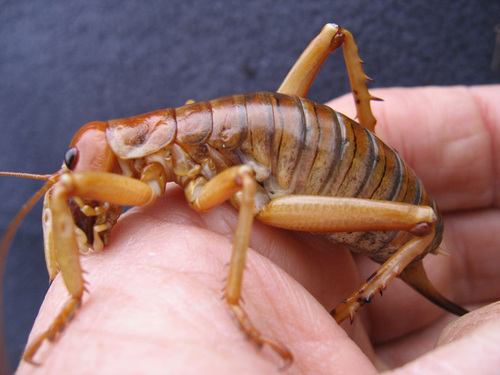
Adults of the Banks Peninsula tree wētā, Hemideina ricta, are red-brown, weigh 4–6 grams, and reach 40–55 millimeters in body length. The head of a mature male is much larger and darker than the heads of females and juvenile males, and bears large mandibles that males use to fight one another. Hemideina ricta is visually similar to Hemideina femorata, another species found in forest fragments on Banks Peninsula. The two species can be distinguished by counting the stridulatory ridges on their abdomen: H. ricta has more than 20 total ridges, while H. femorata has fewer than 16. Though the two species sometimes share the same daytime refuge holes, only a small number of F1 hybrids have ever been found, and no gene flow has been detected between them. The Banks Peninsula tree wētā occurs only on the eastern side of Banks Peninsula, New Zealand. Its entire range is restricted to a roughly 200 km² area between Pigeon Bay and Akaroa Harbour, at elevations between approximately 400 and 800 meters above sea level. Hemideina ricta inhabits pre-existing cavities in trees, wooden posts, crevices, rocks, fallen logs, or the ground. It has been recorded occupying cavities in tree species including lacebark, kanuka, broadleaf, mahoe, and five finger. This wētā generally does not dig its own cavities, instead using cavities created by larvae of other insects. It prefers cavities with a small opening just wide enough for its head to fit through, and a larger internal space. Multiple wētā may share a single cavity at the same time, most often a single adult male with several females. Captive observations report that Banks Peninsula tree wētā mating occurs in April, May, and November. Mating usually takes place inside cavities at night, where groups of females gather for shelter. Adult males fight over control of cavities (and the females within them), and males with larger mandible gapes typically win these contests. After mating, females must leave the safety of their tree cavity to descend to the ground and lay eggs. Egg laying (oviposition) usually happens at night. The female first inspects the ground, then inserts her ovipositor into the soil to lay eggs. She then moves to a nearby patch of ground and repeats the process to lay more eggs, with the full procedure taking around 10–15 minutes. The species' eggs are around 5.9 mm long, weigh about 16.8 mg, and may be black, brown, or white. Eggs take several months to mature, and generally hatch in spring. Hatching is not synchronous; a single batch of eggs can take up to two weeks to all hatch. A female Banks Peninsula tree wētā can lay up to 200 eggs over her lifetime. Juvenile wētā take up to two years to mature into adults, and moult several times as they grow during this period. To moult, the wētā anchors itself to a tree branch with its hind legs and hangs upside down. Body parts emerge from the old skin in a consistent order: first the thorax, followed by the abdomen, the head, the front and hind legs, and finally the antennae. Before moulting, the wētā becomes inactive for a few days and lightens in color. After moulting, the wētā eats its shed skin (exuviae) to recover the valuable proteins it contains. Adult Banks Peninsula tree wētā live for several months, and in some cases can live up to one year.