About Hemideina crassidens (Blanchard, 1851)
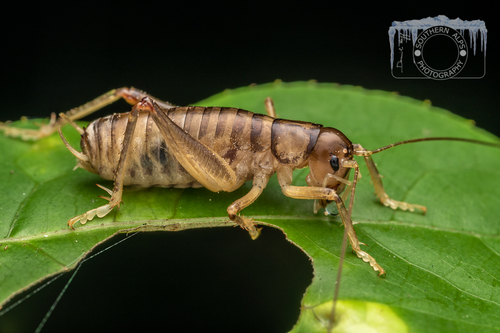
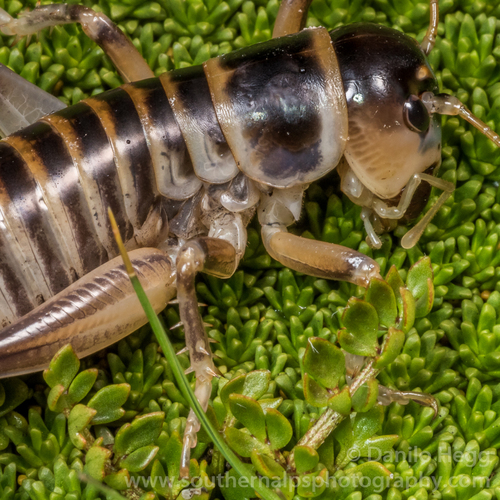
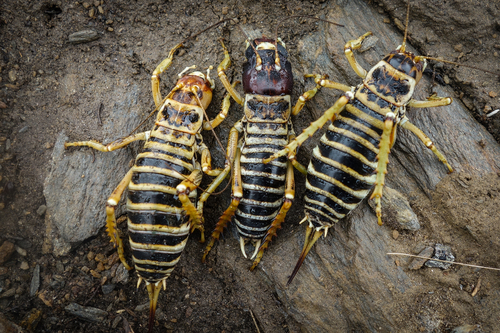
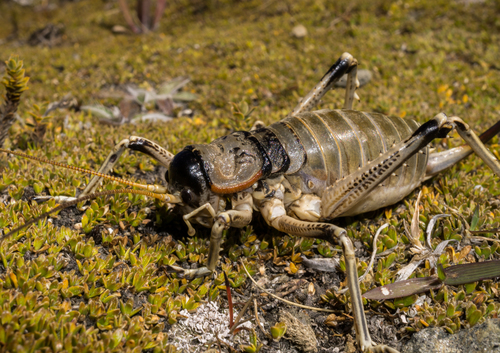
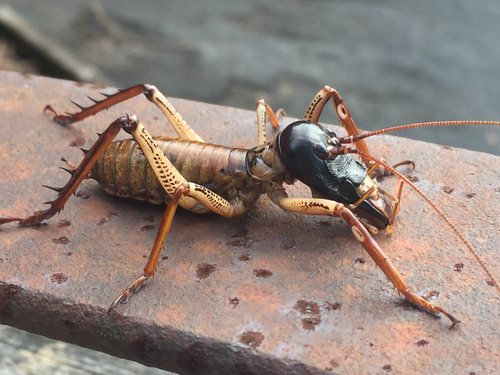
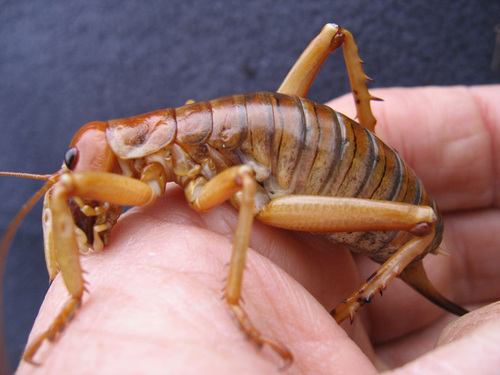
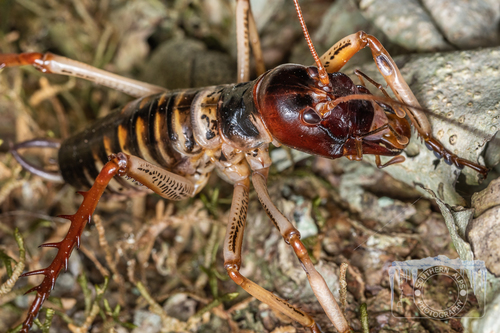
Mature Hemideina crassidens are relatively large, reaching over 6.5 cm in body length. They have smooth, shiny bodies, with abdomens marked by contrasting alternating bands of dark brownish to black and yellow, and a pale underside. This colour pattern matches the uniform of the Wellington rugby team, the Hurricanes, and helps distinguish this species from the Auckland tree wētā (Hemideina thoracica). This species has heavily spined hind tibiae, which it uses in defensive postures. Its long, mobile antennae assist with sensing and navigation, especially in low light conditions. The Wellington tree wētā (Hemideina crassidens) looks identical to the Hawkes Bay tree wētā (Hemideina trewicki), but the two species differ in chromosome count. South Island populations of H. crassidens have 19 chromosomes in males and 20 chromosomes in females, while North Island populations of this species have 15 or 16 chromosomes. The Hawkes Bay tree wētā has 17 chromosomes in males and 18 in females.
Hemideina crassidens is endemic to New Zealand. Its populations are distributed between the Ruapehu district and Wellington district of the North Island, and in the Westland district of the South Island. The closely related native Auckland tree wētā, Hemideina thoracica, is widely distributed across the northern two-thirds of New Zealand's North Island. Researchers have suggested that H. thoracica competitively excludes H. crassidens from the warmer northern regions of the North Island. On Mt Taranaki, H. crassidens is only found at elevations above approximately 700 m above sea level, while H. thoracica occurs on lower slopes where temperatures are slightly warmer. Hemideina crassidens is a nocturnal, arboreal species. It uses holes in tree branches to hide during the day. It typically lives in tree holes, which indicates a reliance on forest habitat. However, many existing populations of this tree wētā occupy scrub habitats, or even use rock refuges when trees are not available.