About Hemidactylus triedrus (Daudin, 1802)
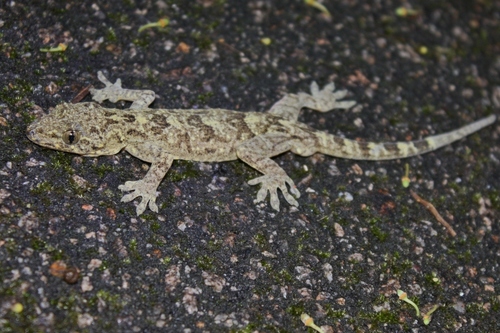
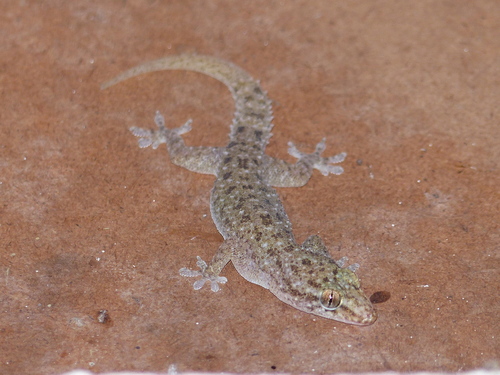
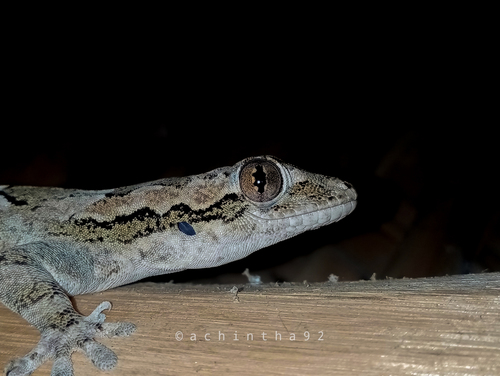
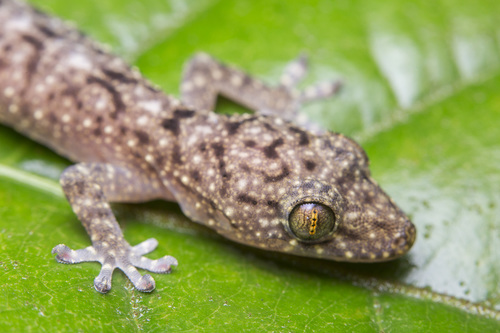
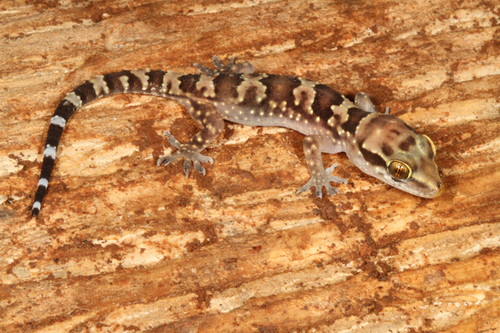
Hemidactylus triedrus (Daudin, 1802) has a large, oviform head. Its snout is longer than the distance between the eye and the ear-opening, and measures 1.4 times the diameter of the orbit. The forehead is concave, and the large, suboval, oblique ear-opening is about half the diameter of the eye. The body and limbs are moderate in size. The digits are free, moderately dilated, with the inner digit well developed; the infra-digital lamellae are slightly oblique, with 6 or 7 lamellae under the inner digits, and 8 to 10 under the median digits. The snout is covered in convex granules that may be keeled; the back of the head has minute granules mixed with roundish tubercles. The rostral scale is subquadrangular, less than twice as broad as it is deep, with a median cleft along its upper edge. The nostril is formed by the rostral scale, the first labial scale, and three or four nasal scales. There are 8 to 10 upper labials and 7 or 8 lower labials. The mental scale is large, triangular or pentagonal, and at least twice as long as the adjacent labials. There are four chin-shields, with the median pair the largest and in contact behind the mental scale. The upper surface of the body is covered with small flat granular scales, and large trihedral tubercles arranged in 16 to 20 more or less irregular longitudinal series. These tubercles vary slightly in size between specimens, but the largest never exceed two fifths the diameter of the eye. Abdominal scales are large, smooth, rounded, and imbricate. Males have a mesially interrupted series of preanal pores, with 6 to 8 pores on each side. The tail is rounded, faintly depressed, and tapering. Its upper surface is covered with irregular, small, smooth imbricated scales and rings of large, pointed, keeled tubercles, while its underside has a median series of transversely dilated plates. The dorsal coloration is light pinkish brown, usually with more or less defined transverse darker bands bordered by pure white tubercles that are surrounded by deep-brown rings. Juveniles have very regular dark brown bars, with four dark bars between the head and the hind limbs. A more or less defined dark-brown streak, edged with white along its upper margin, runs along the side of the head through the eye. The lower surfaces are white. The length from snout to vent is 3.7 inches, and the tail is 3.8 inches long. This species is distributed in Sri Lanka, Pakistan (from Karachi eastward), and India. The race lanka is found in Sri Lanka, with its type locality recorded as Ceylon.