About Hemidactylus reticulatus Beddome, 1870
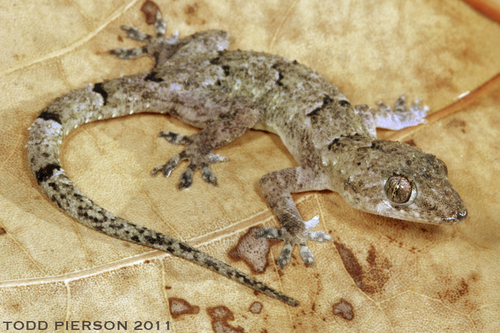
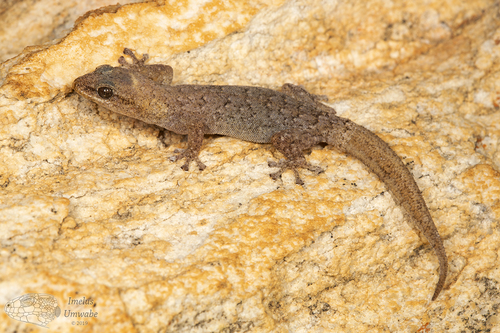
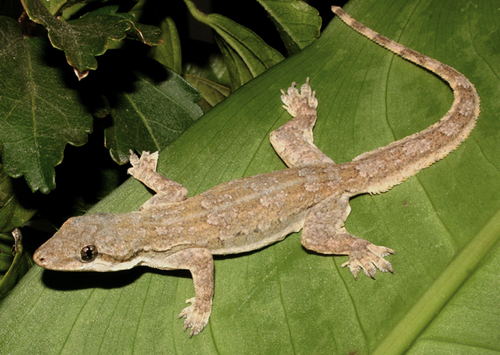
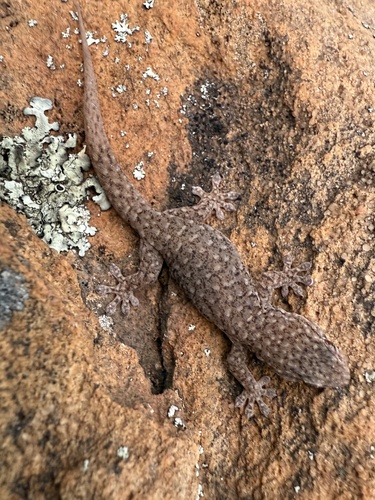
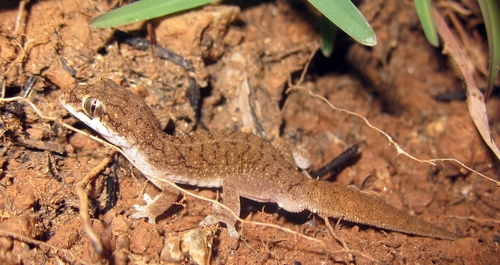
Head short, oviform, very convex; the snout is slightly longer than both the distance between the eye and ear-opening and the diameter of the orbit; the forehead is not concave; the ear-opening is small and roundish. Body and limbs are short. Digits are short, free, with very short distal joints, and moderately dilated; there are 5 or 6 lamellae under the inner digits, 7 or 8 under the fourth finger, and 8 or 9 under the fourth toe. The snout is covered with keeled granules; the rest of the head is covered with smaller granules intermixed with round tubercles. The rostral scale is four-sided, not twice as broad as deep, with a median cleft above; the nostril is pierced between the rostral, the first labial, and three or four nasals; there are 9 or 10 upper labials and 7 to 9 lower labials; the mental scale is large, triangular or pentagonal; there are four chin-shields, with the inner pair the largest and in contact behind the point of the mental. The upper body is covered with coarse granules intermixed with numerous irregularly arranged, small, round, keeled tubercles. Abdominal scales are rather small, cycloid, imbricate, and smooth. Males have 6 to 9 preanal pores arranged in an angular series. The tail is cylindrical and tapering; it is covered above with small granular scales and rings of six or eight large conical tubercles, and beneath with uniform small imbricated scales. The dorsal coloration is brown, with a network of darker lines; many of the tubercles are whitish; lower surfaces are whitish, and the throat is sometimes vermiculated with brown. This species is distributed in Southern India, in the states of Karnataka, Tamil Nadu, Telangana, and Andhra Pradesh. It strongly prefers rocky hillocks and outcrops, and occurs from near sea level to over 1000 m. Its type locality is Kollegal, Mysore State.