About Hemidactylus maculatus Duméril & Bibron, 1836
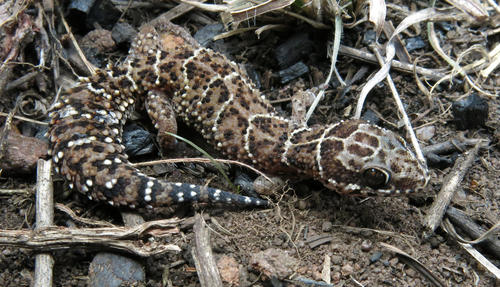
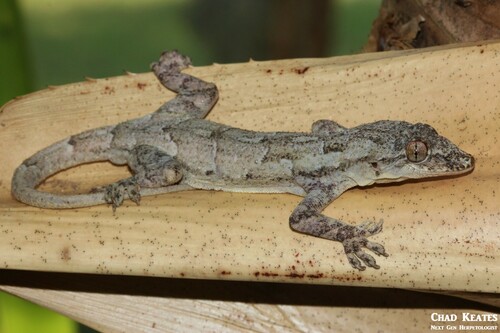
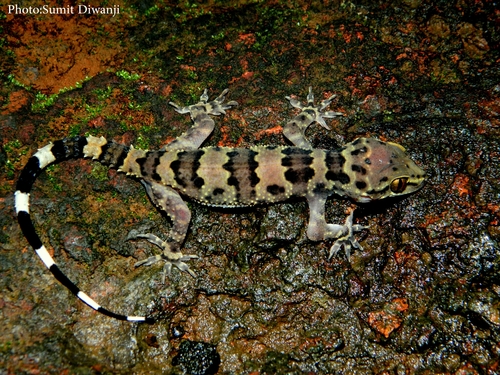
This species is scientifically named Hemidactylus maculatus Duméril & Bibron, 1836. Its head is large and oviform; the snout is longer than the distance between the eye and the ear-opening, and measures 1.25 times the diameter of the orbit. The forehead is concave, the canthus rostralis is swollen, and the ear-opening is large and oval. The body and limbs are moderate in build. Digits are moderately dilated and free, with the inner digit well developed; infradigital lamellae are almost perfectly straight, numbering 9 to 11 under the inner digit, and 12 or 13 under the median digit. The anterior part of the head is covered with convex granular scales, which are smaller in the frontal concavity; the posterior part of the head is covered with minute granules mixed with round tubercles. The rostral scale is subtetragonal, less than twice as broad as it is deep, and has a median cleft above. The nostril is pierced between the rostral, the first labial, and three or four nasal scales. There are 10 to 12 upper labials and 9 or 10 lower labials. The mental scale is large, triangular or pentagonal, and twice as long as the adjacent labials. There are two pairs of chin-shields; the inner pair is larger and elongate, and lies in contact behind the mental scale. Upper body surfaces are covered with minute granular scales mixed with moderate-sized trihedral, more or less strongly keeled tubercles; the largest tubercles measure no more than one third the diameter of the eye. These tubercles are arranged very irregularly on the back, forming approximately 20 longitudinal series. Abdominal scales are smooth, roundish, and imbricate. Males have a long series of femoral pores, 19 to 25 on each side, interrupted across the preanal region. The tail is rounded, tapering, and depressed. Its upper side is covered with small irregular keeled scales, and has 6 or 8 longitudinal series of large trihedral tubercles; its underside has a median series of transversely enlarged plates. The upper side of the species is brown, with darker spots that are generally confluent into transverse undulating bands on the back. Two more or less distinct dark streaks run along each side of the head, passing through the eye. Lower surfaces are dirty white. The length from snout to vent is 4.5 inches, and the tail is 5 inches long. It is distributed in Southern India and Sri Lanka. The subspecies race hunae is found in India (Malabar, Tirunelveli, Salem, near Madras) and Sri Lanka. Smith restricted the species' type locality to Bombay in 1935.