About Hemidactylus leschenaultii Duméril & Bibron, 1836
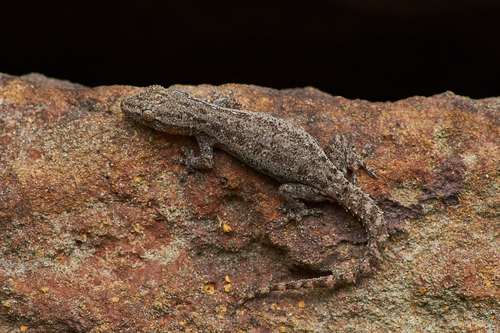
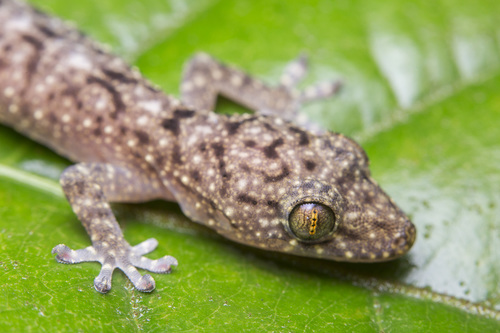
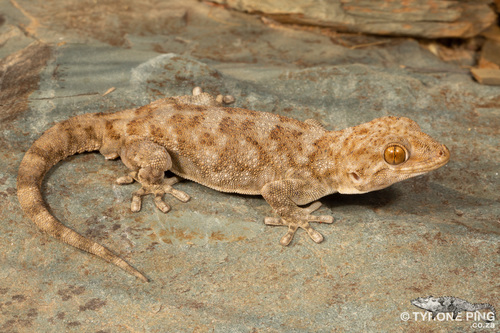
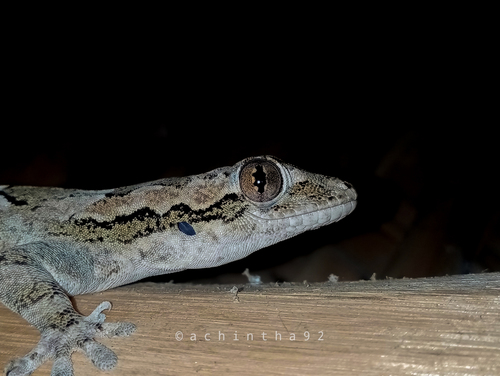
Hemidactylus leschenaultii Duméril & Bibron, 1836 has the following morphological characteristics. Its snout is longer than the distance between the eye and the ear-opening, and measures 1.33 to 1.40 times the diameter of the orbit. The forehead is concave, and supraorbital ridges are prominent in fully grown adult specimens. The ear-opening is rather large, oval, and oriented vertically. The species has moderately sized body and limbs. A slight skin fold runs along the side of the belly, from the axilla to the groin. The digits are free, strongly dilated, and the inner digits are well developed. There are 6 or 7 (rarely 5) lamellae under the inner digits, and 9 to 11 lamellae under the median digits. The posterior part of the head is covered in minute granules, while the anterior part is covered in larger granules. The rostral scale is four-sided, and is not twice as broad as it is deep, with a median cleft above it. The nostril is pierced between the rostral scale, three nasal scales, and generally the first upper labial scale. There are 10 to 12 upper labial scales and 8 or 9 lower labial scales. The mental scale is large, and shaped triangular or pentagonal. There are two pairs of chin-shields, with the inner pair being larger and in contact behind the mental scale. The upper surface of the body is covered with small granules, which may be uniform or interspersed with more or less numerous scattered round tubercles. Abdominal scales are moderate-sized, cycloid, and imbricate. Males have a series of femoral pores that is interrupted on the preanal region, with 12 to 16 pores on each side. The tail is depressed, flat on its underside, covered above with small smooth scales and six longitudinal series of conical tubercles; it has a median series of transversely dilated plates on its underside. The dorsal coloration is grey, with darker markings that form undulating cross-bars, rhomboidal spots on the middle of the back, or regular longitudinal bands; a dark band extends from the eye to the shoulder. The lower surfaces are white. The body length from snout to vent is 3.20 inches (8.1 cm), and the tail length is 3.25 inches (8.3 cm). This species is found in southern India, Sri Lanka, Pakistan, and Oman, with its type locality being Ceylon. Its preferred natural habitat is forest, at altitudes ranging from sea level to 1,000 m (3,300 ft). Hemidactylus leschenaultii is oviparous.