About Hemidactylus garnotii Duméril & Bibron, 1836
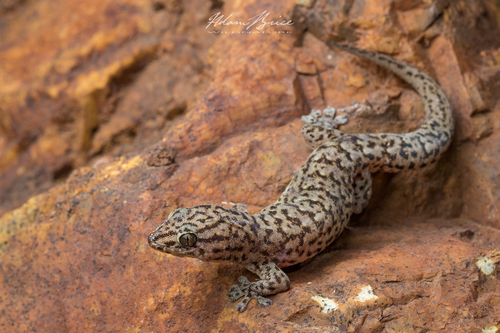
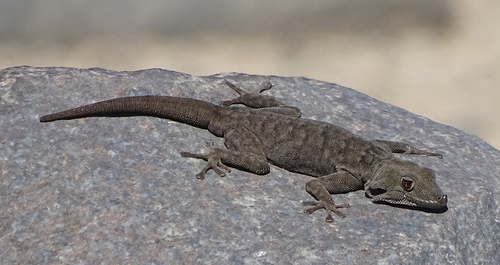
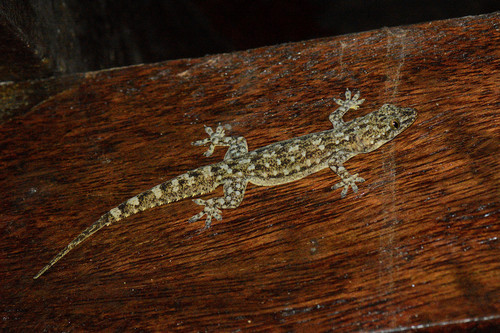
Hemidactylus garnotii, commonly called the Indo-Pacific gecko, closely resembles its closest living relative, H. frenatus. However, H. garnotii individuals are typically much larger than H. frenatus, and have more prominent markings on their back. The belly of H. garnotii is usually pale yellow or orange. The species also has two large, spiky rows of scales, with one row running along each side of the tail. These scales are soft, match the color of the tail, and their function is currently unknown. The Indo-Pacific gecko is native to South Asia, Southeast Asia, Polynesia, and the east coast of Australia. It can also be found in Remote Oceania, specifically New Zealand, Hawaii, and Fiji, as well as in Seychelles, the Bahamas, and tropical regions of the United States. It is classified as an invasive species in the U.S. states of Hawaii, Florida, and Georgia. In Australia, the Indo-Pacific gecko only occurs in a small number of populations, but these populations are well-established; they are found most notably in Sydney and Fraser Coast. H. garnotii reproduces exclusively via parthenogenesis, and all individuals of the species are female. Like all reptiles, H. garnotii lays eggs, but due to its parthenogenetic reproduction, its eggs can hatch without requiring fertilization from a male.