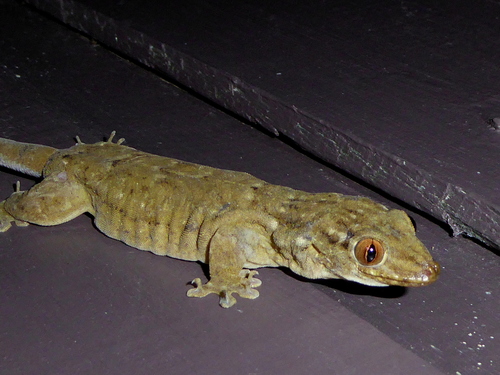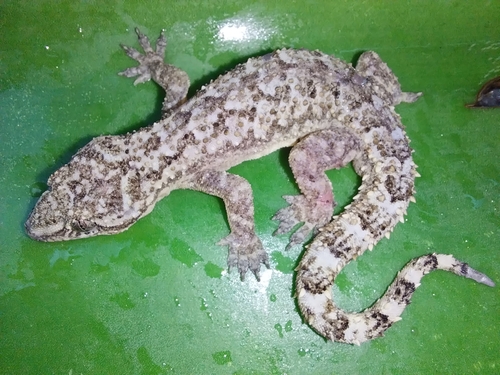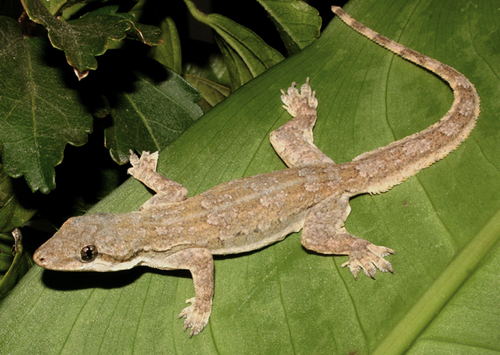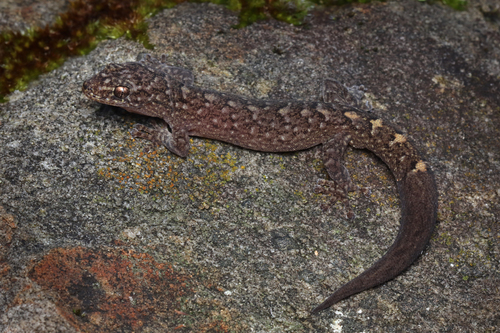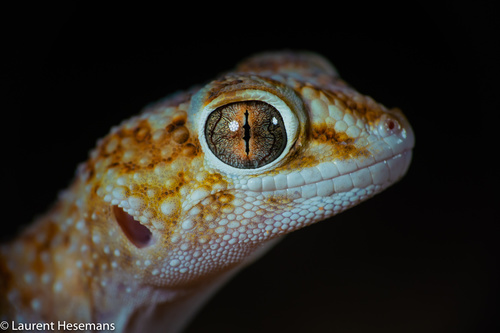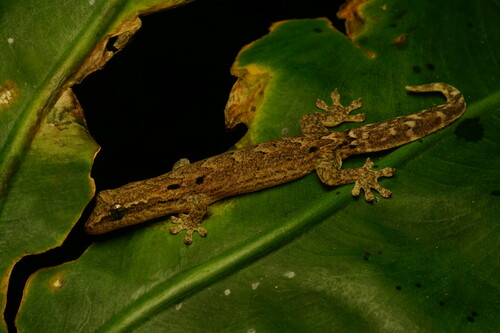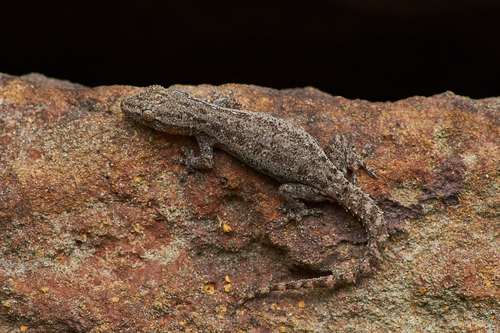
About Hemidactylus frenatus Duméril & Bibron, 1836
The common house gecko, scientifically named Hemidactylus frenatus, is a gecko species native to South Asia, Southeast Asia, and Near Oceania. It has many other common names, including Asian house gecko, Pacific house gecko, wall gecko, house lizard, tiktiki, chipkali, and moon lizard. This species is nocturnal: it hides during the day and forages for insects at night. It can often be seen climbing the walls of houses and other buildings to hunt insects drawn to porch lights, and is easily identified by its characteristic chirping. Adult common house geckos reach a length of 7.5 to 15 cm (3 to 6 inches), and have a typical lifespan of around 7 years. They are non-venomous and not harmful to humans. Most medium to large common house geckos are docile, but may bite if they feel distressed, and their bite can pierce human skin. As a tropical species, the common house gecko thrives in warm, humid habitats, including rotting wood (where it hunts for insect prey) and urban landscapes in warm climates. It is highly adaptable, preys on insects and spiders, and often displaces other gecko species that are less robust or less behaviorally aggressive. In parts of Australia and Papua New Guinea, it is often confused with the dubious dtella, a similar native lizard. The common house gecko’s name is well-deserved, as it has a clear preference for urban environments. This synanthropic species tends to hunt for insects very close to urban artificial lights. While it has been found in bushland, current evidence indicates it strongly prefers urban habitats, and its distribution is mostly limited to areas within or near city limits. It favors light areas that are close to cracks or other escape sites. Geckos that do not have immediate access to escape from potential danger adjust their behavior accordingly, emerging later at night and retreating earlier in the morning. When not found in urban landscapes, it prefers relatively dense forest or eucalypt woodland located near closed forest. Its preference for urban habitats gives it easy access to its preferred foods. The bulk of the common house gecko’s diet consists of invertebrates, which it mostly hunts around urban structures. Its primary invertebrate prey includes cockroaches, termites, some bees and wasps, butterflies, moths, flies, spiders, and multiple groups of beetles. It also feeds on molluscs and smaller geckos. There is limited evidence that cannibalism can occur in laboratory conditions, but this behavior has not yet been observed in wild common house geckos. The common house gecko is widespread across the tropics and subtropics, and occupies an ecological niche similar to that of other Hemidactylus species. Although it is native across Southeast Asia, both deliberate and accidental recent introductions have led to it being recorded in the Deep South of the United States, large areas of tropical and subtropical Australia, and many countries in South America, Central America, the Caribbean (including the Dominican Republic), Africa, South Asia, and the Middle East (including Bahrain, Jordan, Qatar, Kuwait, Saudi Arabia, Oman, and the United Arab Emirates). Most recently, this species has invaded the Lesser Antilles in the Caribbean, and is now present on the islands of Saint Martin, Saint Barthélemy, Saba, as well as on Sint Eustatius, Dominica, and Saint Lucia. Its ability to tolerate a wide range of latitudes is partially enabled by its capacity to enter brumation during colder months. Climate change and increasing urbanization interact synergically to greatly expand the expected future distribution of the common house gecko. Due to concerns about its potential as an invasive species that threatens native gecko species, efforts are underway to limit its introduction and spread in at-risk locations. In Mexico, H. frenatus was first collected in Acapulco, Guerrero, in March 1895, and was found to be well established in Acapulco and surrounding regions by the early 1940s. It was likely introduced to Mexico through shipping and cargo. Today, H. frenatus occurs across all lowland regions of Mexico on both Atlantic and Pacific slopes, including the Yucatan Peninsula and Baja California, with confirmed records from 21 of Mexico’s 32 states. Most records of H. frenatus in Mexico come from buildings like homes, hotels, and other urban structures, with only a few reports of the species in natural habitats. Its impact on native Mexican fauna, if any, remains unknown.