About Hemidactylus brookii Gray, 1845
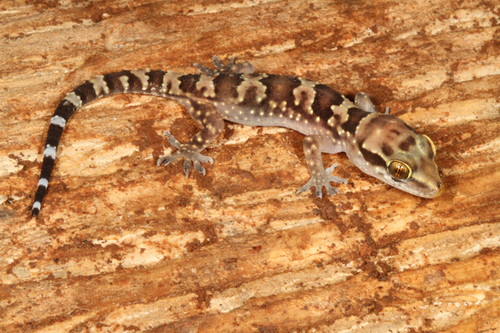
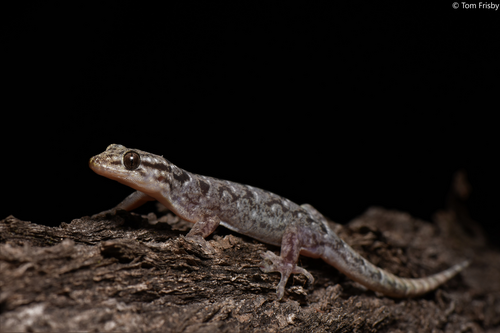
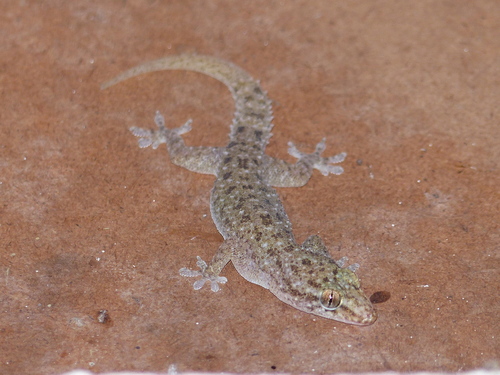
Hemidactylus brookii Gray, 1845 has a snout that is somewhat longer than the distance between the eye and the ear-opening, and nearly twice the diameter of the orbit. The forehead is concave, and the ear-opening is small, oval, vertical, and about one third the diameter of the eye. Very small round tubercles are present on the occiput. The rostral scale is quadrangular, with a median cleft; the nostril is bordered by the rostral, the first upper labial, and three nasals, with the upper nasal not in contact with its opposite counterpart. There are 8 to 10 upper labials and 7 to 9 lower labials. The mental scale is large and triangular; there are two or three pairs of chin-shields, with the median pair forming a suture. Scales on the throat are granular. The body is covered with small granules, mixed with large keeled trihedral tubercles arranged in 16-20 longitudinal series; the keels of the outer tubercles are indistinct. The diameter of the largest tubercles on the flanks is larger than the diameter of the ear-opening. Ventral scales are larger than throat scales, cycloid, and imbricate. Males have 7-20 femoral pores on each side. The tail is depressed and annulate, with rows of 8 or 6 spine-like tubercles, and has a series of transversely dilated plates on its underside. Limbs are covered in granular scales, with large keeled tubercles on the upper part of the hind limb; digits are free and dilated, with a long free distal joint, and 3-6 lamellae under the inner toes, 6-8 under the median toes. The upper body is yellowish-brown with irregular dark spots; one or two dark lines run along the side of the head, passing through the eye, and the lips have dark bars. Lower body parts are white, and all scales are finely dotted with dark brown. Young specimens have cross lines of white tubercles on the back, and all tubercles on the tail are white. The combined length of the head and body is 58 millimetres (2.3 in), and the tail is 60 millimetres (2.4 in).
Geographic range, organized by subspecies: Hemidactylus brookii brookii: Senegal, Togo, Angola, Cape Verde, Tanzania, South Africa, Gambia, Democratic Republic of the Congo, Ghana, Eritrea, Ethiopia, Mali, Central African Republic, Ivory Coast, Cameroon, Sudan (Dagana, Goree Dondo, Cuanza River, Atakpame), India (Himalaya), Bhutan, Thailand, Maldives, Malaysian Peninsula, Sri Lanka, Myanmar (Tsagain), Pakistan, Bangladesh, Nepal, Indonesia (Borneo), Mexico, Honduras, Haiti, Antilles, Cuba, Hispaniola, Puerto Rico, Port-Au-Prince, Trinidad, Colombia Hemidactylus brookii angulatus: Sudan, Uganda, south to Tanzania, west to Senegal, Zanzibar, Pemba Island. The type locality for this subspecies is the west coast of Africa (Gabon) Hemidactylus brookii leightoni: Venezuela (Zulia), Colombia. The species type locality is "Ada Foah (Guinea)" (now Ghana), originally published as Hemidactylus guineensis PETERS 1868