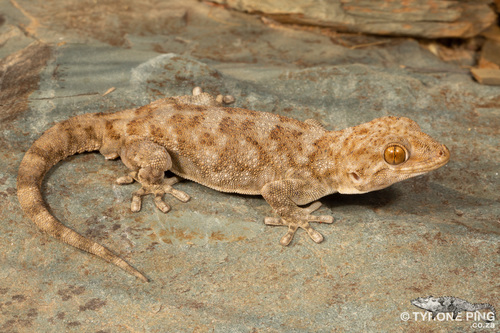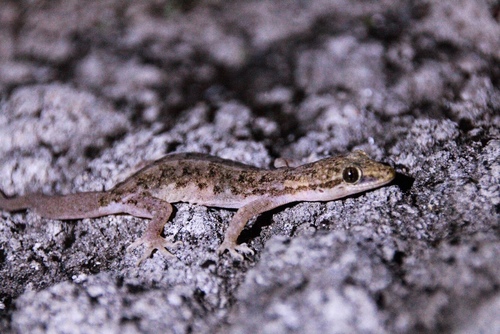
About Hemidactylus bowringii (Gray, 1845)
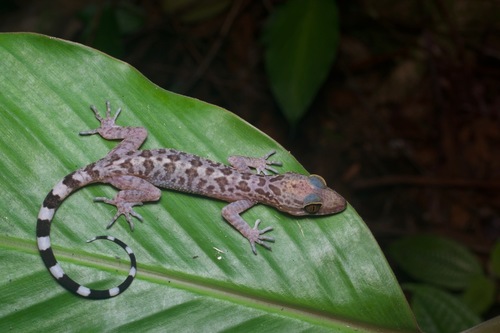
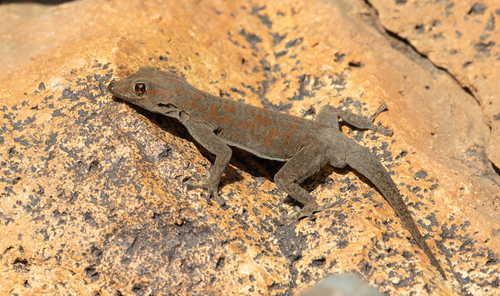
This species has the scientific name Hemidactylus bowringii (Gray, 1845). Boulenger provided the following formal description of H. bowringii in 1885: The snout is longer than the distance between the eye and the ear-opening, measuring 1.4 times the diameter of the orbit. The forehead is slightly concave, and the ear-opening is small and roundish. The body and limbs are moderate in size, with a slight fold of skin running along the flank. The digits are free, moderately dilated, and the inner digits are well developed. The infradigital lamellae are obliquely curved: 5 lamellae lie under the thumb, 7 or 8 under the fourth finger, 5 or 6 under the first toe, and 9 or 10 under the fourth toe. Upper body surfaces are covered in uniform small granular scales, which are largest on the snout and smallest on the occiput. The rostral scale is four-sided, twice as broad as it is deep, with a median cleft above it. The nostril is pierced between the rostral, the first labial, and three or four nasal scales. There are 9 to 11 upper labials and 7 or 8 lower labials. The mental scale is large and triangular, followed by a pair of chin-shields, with an additional outer pair of much smaller chin-shields. Abdominal scales are moderate in size, cycloid, and imbricate. Males have a mesially interrupted series of preanal pores, with 13 pores on each side. The tail is depressed, rounded, and oval in cross-section; it is covered above with uniform small scales, and has a median series of transversely dilated plates beneath. The upper body is light brown with darker spots, which sometimes tend to form four longitudinal bands on the back. Small whitish spots are frequently present on the body and limbs. A dark streak passes through the eye, and the upper surface of the tail bears small chevron-shaped markings. Lower surfaces are whitish. The total length from snout to vent is 1.3 inches (3.3 cm), and the tail is 2 inches (5.1 cm) long. Hemidactylus bowringii is distributed across East Asia, with recorded populations in Bhutan, Nepal, southern China, Taiwan, Hong Kong, Vietnam (specifically Hanoi and Hon Thom Island), and Japan (specifically the Ryukyu Islands, also called Okinawa). The preferred natural habitat of H. bowringii is forest, at altitudes ranging from sea level up to 1,250 m (4,100 ft). The species has also been found in plantations and around man-made structures in urban areas. Hemidactylus bowringii is oviparous. It produces clutches of 2–3 eggs, which hatch after 30 days of incubation.