About Hemichroa crocea (Geoffroy, 1785)
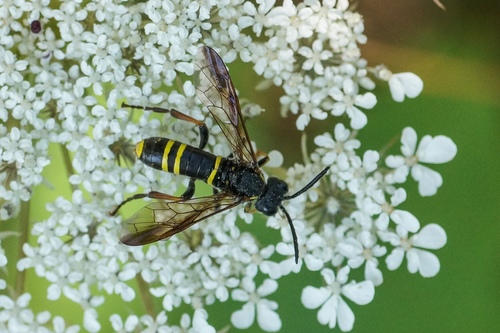
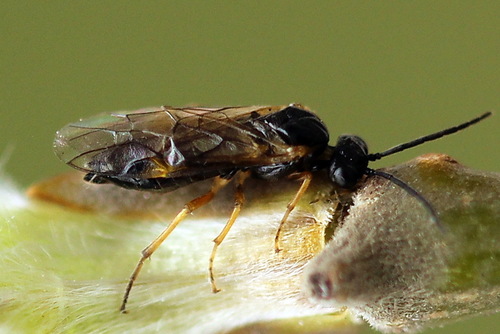
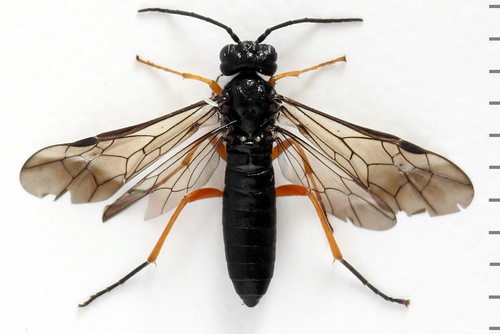
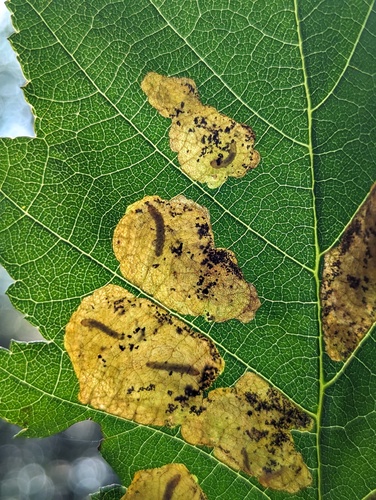
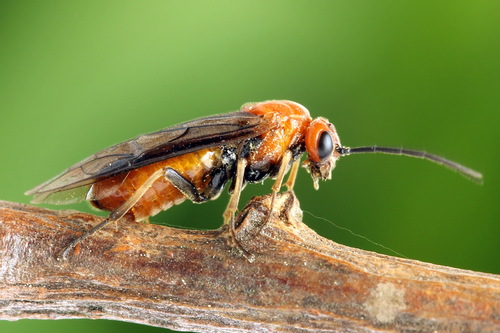
The adult striped alder sawfly, Hemichroa crocea, has an orange-red thorax, a black abdomen, and translucent wings. Its larvae look similar to caterpillars, reaching about 20 mm (0.8 in) long when fully grown. Fully grown larvae have black heads and yellowish bodies, with a dark brown stripe along each side of the back, plus two rows of dark brown markings on each side. This species is probably native to Europe, and is now found in southern Canada and the northern United States, where it is continuing to extend its range across North America. The first generation of adult striped alder sawflies fly in late May. Females lay eggs inside slits cut beside the midrib of their host plant’s leaves. After the eggs hatch, the larvae stay grouped and feed together. As they feed, they consume the entire leaf except for the midrib and veins, then move on to feed on the next leaf. These first-generation larvae reach full size by July, then move down to the ground, where they spend the winter inside a thin-walled prepupal cocoon. This cocoon is formed from cemented-together sand and soil particles. A second generation of adults emerges in late July and August. Larvae from this second generation feed on host plants through August and September, before also overwintering as prepupae in the ground.