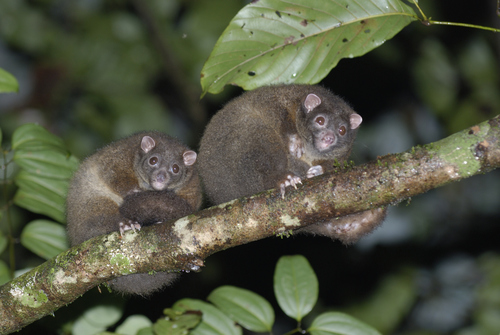
About Hemibelideus lemuroides (Collett, 1884)
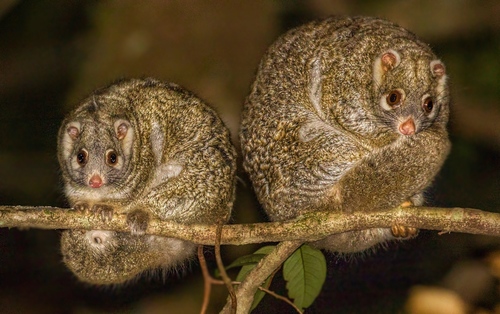
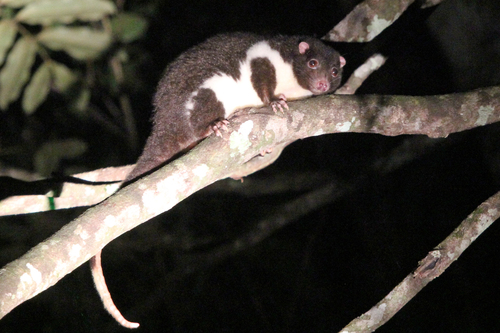
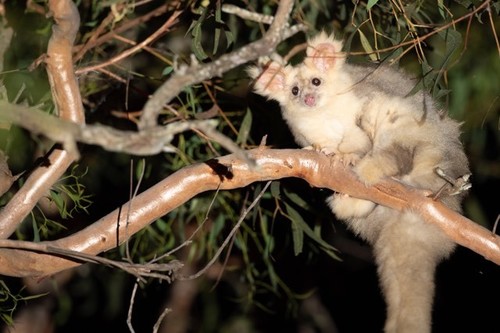
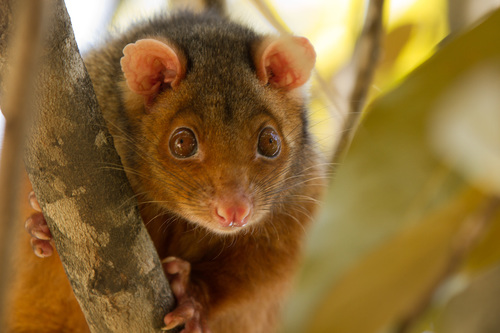
The lemuroid ringtail possum (Hemibelideus lemuroides) is also commonly called the lemur-like ringtail possum or the brushy-tailed ringtail, and it is a very distinctive member of the ringtail possum group. It was originally classified as a greater glider (Petauroides volans). Its genus name Hemibelideus literally translates to "half-glider", because belideus is a diminutive form of Petaurus, the genus name that means "glider". The species is named for its facial features, which look visually similar to those of the unrelated primate lemurs: it has a short snout, large forward-facing eyes, and small ears. Like other gliding possums, it has musculo-skeletal adaptations that support a leaping lifestyle. Its long, prehensile tail is an additional adaptation to its arboreal habitat, and its tail is bushier than the tails of other ringtail possums. It can be told apart from the greater glider by its lack of a gliding membrane and much shorter, hairless ears. This is a social possum species, and it occurs in two main colour forms. The more common form is brownish-gray with a yellowish underbelly; the rare white form historically occurred in the Daintree Rainforest. The rare white form was last recorded in 2005 at Mount Lewis National Park, and was considered nearly extinct in 2008. The entire range of this possum covers only around 300,000 total hectares, located between Ingham and Cairns in Queensland, Australia. It also has an isolated population on the Mount Carbine Tableland; both of these ranges lie within the Wet Tropics World Heritage Area. The species is strictly arboreal, living in the high canopies of mature forests, and favours specific tree types. It is most often found at elevations between 480 and 900 metres. Adults have a body length of 30 to 38 cm, a tail length of 30 to 35 cm, and a body weight between 810 and 1140 grams. Stephen Williams, a climate change and biodiversity researcher at the Centre for Tropical Biodiversity and Climate Change at James Cook University, Queensland, reported that no lemuroid ringtail possums were observed for several years after the 2005 heat waves. A small number were first spotted again in 2009, when three individuals were observed in Daintree National Park on Cape York Peninsula, and numbers slowly increased as the population began to recover. In 2009, Williams stated there was no evidence that the white colour variant would be affected more severely than the common brownish-gray variant. Another major heatwave hit the Cairns region in November 2018, bringing the highest temperatures recorded since official record-keeping began; even the highest mountain in the wet tropics reached 39 °C during this event. According to Williams, many tropical species have not evolved body cooling mechanisms to cope with extreme heat, and can die when exposed to temperatures above 29 °C. Williams noted that over the 15 years before his statement, species had gradually disappeared from lower elevations. This has forced total populations to contract into smaller areas at higher elevations, leading to overall population decline. This contraction creates particular pressure for species that live only on mountain summits, like the lemuroid ringtail possum, which have no higher habitat to move into; the nearest suitable rainforest is 1000 kilometres away.