About Hemerocallis fulva (L.) L.
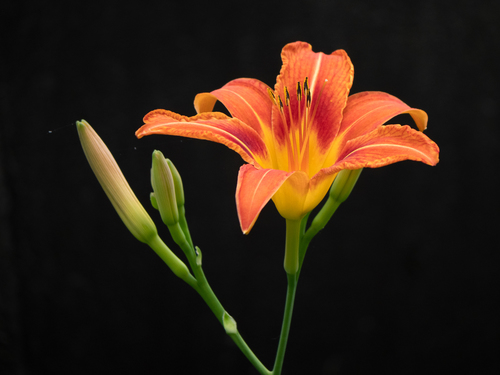
Hemerocallis fulva (L.) L. is an herbaceous perennial plant that grows from tuberous roots, with stems reaching 40–150 centimetres (16–59 inches) in height. Its leaves are linear, measuring 0.5–1.5 metres (1+1⁄2–5 feet) long and 1.5–3 cm (1⁄2–1+1⁄4 in) broad. The flowers are 5–12 cm (2–4+3⁄4 in) across, colored orange-red, with a pale central line on each tepal. Flowers form on scapes bearing between ten and twenty blooms from early summer through late autumn; individual flowers open one after another, and each flower lasts only one day. Its fruit is a three-valved capsule 2–2.5 cm (3⁄4–1 in) long and 1.2–1.5 cm (1⁄2–5⁄8 in) broad that splits open at maturity to release seeds. Both diploid and triploid forms of this species grow in the wild, but most cultivated plants are triploids. Triploid plants rarely produce seeds, and primarily reproduce vegetatively via stolons. At least four botanical varieties are currently recognized: the typical triploid var. fulva; the diploid, long-flowered var. angustifolia (synonym: var. longituba); the triploid var. Flore Pleno, which has petaloid stamens; and the evergreen var. aurantiaca.
Orange daylily is native to Asia, ranging from the Caucasus east through the Himalaya to China, Japan, and Korea. It persists well in locations where it is planted, making it an excellent garden plant. Hemerocallis fulva var. fulva has escaped from cultivation across much of the United States and parts of Canada, and has become a weedy or invasive species. It persists in areas where garden waste is dumped, and spreads more or less rapidly via vegetative growth into woods, fields, and along roadsides and ditches. This characteristic gives it the common name ditch lily. It forms dense stands that displace native vegetation, and is often mistaken for a native species. Hemerocallis fulva is an invasive non-native plant in parts of the United States, and is included on lists of plants to avoid planting in some states, including Delaware, Maryland, Virginia and other mid-Atlantic states.
Hemerocallis fulva has been cultivated in Europe, and has naturalized in many European countries, since at least the 16th century. Several modern cultivars exist, grown as ornamental plants. Because most cultivated varieties are sterile triploids, and all varieties spread via subterranean bulb offsets, the most common and simplest propagation method is division of roots or bulbs. H. fulva is a long-lived perennial adaptable to a range of climatic conditions. It is a vigorous grower in nearly any location, and even thrives in difficult areas where other plants do not grow well. It grows well in full sun to open shade, and is drought tolerant. H. fulva is winter hardy to USDA Zone 4. All parts of Hemerocallis species are seriously and often fatally toxic to cats, and somewhat toxic to dogs, like all lilies in the "true lily" and "daylily" families. Cats are particularly vulnerable, as their grooming behavior causes them to lick pollen that has accidentally transferred to their fur.
The flowers, leaves, and tubers of H. fulva are edible. When very young, the leaves and shoots can be eaten raw or cooked; older leaves and shoots become too fibrous to eat. The flower petals and young tubers can also be eaten raw in salads, stir-fried, or cooked in other ways. Petals are reported to have a better flavor when cooked, but can also be fried for storage, or dried and used as a thickener in soups or sauces. Cooked flower buds, served with butter, taste similar to green beans or wax beans. The tubers make a good potato substitute, with a reportedly "nutty" flavor.