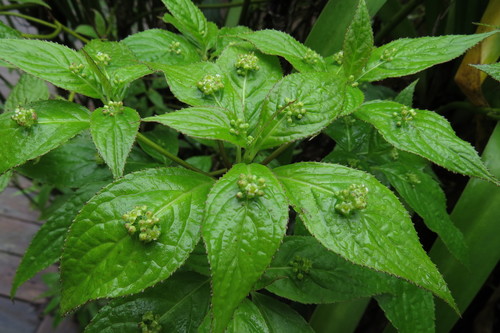
About Helwingia japonica (Thunb.) F.Dietr.
Helwingia japonica (Thunb.) F.Dietr. is a dioecious shrub that grows 1 to 2 metres (3.3 to 6.6 ft) tall, and spreads 1–1.5 metres (3.3–4.9 ft) wide. Its green leaves measure 6–12 centimetres (2.4–4.7 in) in length, with concave midveins and lateral veins. Flowers emerge from the center of leaf midribs, arranged in simple umbel inflorescences. This species is dioecious, meaning male and female sexual functions grow on separate individual plants. On male specimens, 3–10 small green or purplish-green flowers develop, though only 3–5 open at the same time; male flowers have a small calyx, 3–5 stamens, and one long pedicel. Female plants produce 1–3 flowers each, with short pedicels, one pistil, 3–5 stigma branches, an inferior ovary holding 3–5 ovules, and no stamens. Flowering occurs between April and May, and fruiting takes place from August to September. Successful reproduction requires pollination, after which female flowers develop into small black or red berry fruits. This species is naturally found in moist, rich soil in forests and thickets of hills and low mountains, at elevations ranging from 100–3,400 metres (330–11,150 ft). Its documented native range includes Japan, Bhutan, South Korea, Myanmar, and multiple provinces in China. For cultivation, Helwingia japonica grows best in moist, well-drained, partially shaded locations. It can tolerate minimum temperatures of −7 °C (19 °F), and requires low overall maintenance. To produce fruit, garden plantings must include both male and female plants. Mature seeds can be collected from ripe fruits, rinsed, dried, and either stored or sown immediately. Helwingia japonica is edible; its young leaves are used for cooking, including preparation boiled or cooked with rice, and its flowers are also eaten. One source records medicinal uses for this plant: it is used to activate blood circulation, remove blood stasis, and relieve pain during urination, while its fruit is used to ease stomach aches.

