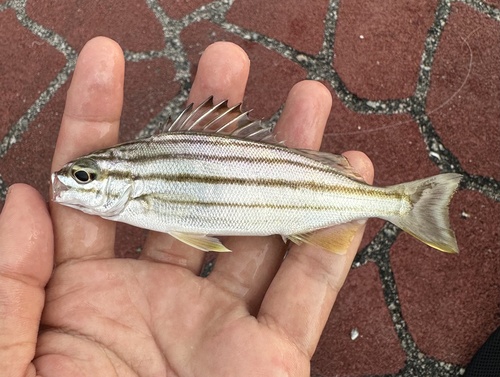
About Helotes sexlineatus (Quoy & Gaimard, 1825)
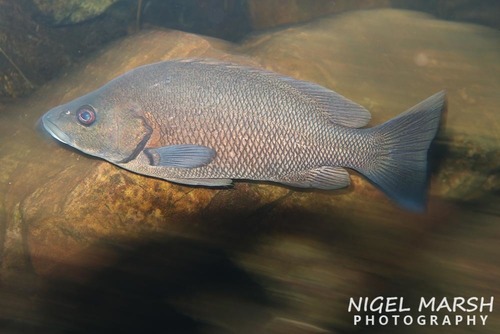
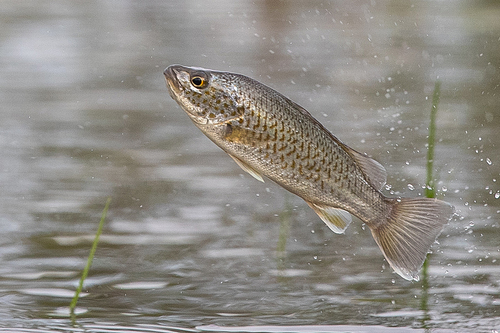
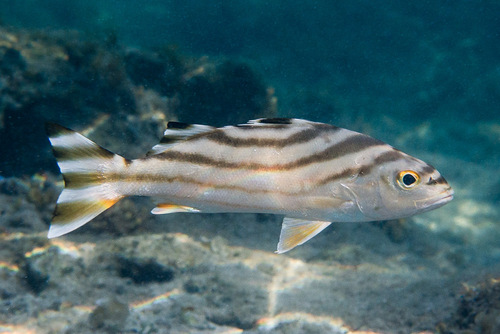
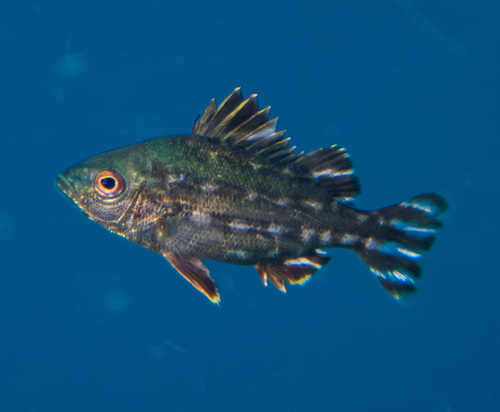
The Eastern striped grunter, scientifically named Helotes sexlineatus (Quoy & Gaimard, 1825), is a small grunter species with an oblong, slightly laterally compressed body. Its jaws are equal in length, and it has a small oblique mouth whose tip extends halfway between the nostril and the front edge of the eye. It has tricuspid teeth, all of which have cusps of the same size, arranged in bands on each jaw; the outermost row holds the largest teeth. The dorsal fin has 11 or 12 spines and 9 to 11 soft rays. The spiny section of the dorsal fin is arched, with the fifth or sixth spines longer than the others, and the second-last spine is shorter than the last spine. The anal fin has 3 spines and 9 to 11 soft rays. The lateral line is made up of 76 to 87 pored scales. The upper body is greyish or bluish, while the lower body is silvery or whitish. There are 5 to 8 narrow, dark brown or black horizontal stripes running along the body. The midlateral stripe reaches the base of the caudal fin. The membranes between the spines in the spiny portion of the dorsal fin have a black margin. There is a dark blotch on the body behind the nape, and the intensity of this blotch's pigment varies between individuals. The caudal fin has a dark border and several bands of faint spots at its base, and does not have obvious transverse black striping. This species reaches a maximum total length of 15 centimetres (5.9 in). The Eastern striped grunter is distributed from Singapore east to Australia and north to China and Okinawa. It has been reported from India, but this record requires confirmation. It occurs at depths of 1 to 30 metres (3.3 to 98.4 ft), and forms schools in sheltered seagrass beds, sandy areas, and coastal reefs. It is most abundant in weedy areas near estuary mouths. After the larval stage, juveniles settle and live in seagrass beds. It is an omnivorous species, though small fishes and invertebrates make up the majority of its diet. Male Eastern striped grunters guard and fan the eggs of the species.