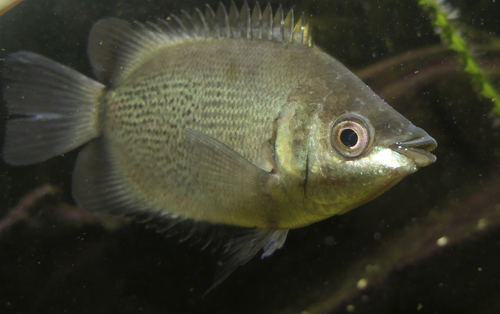
About Helostoma temminckii Cuvier, 1829
This species, commonly called kissing gourami, has the scientific name Helostoma temminckii Cuvier, 1829. It has a body shape typical of gouramis: deep and strongly compressed laterally. Its long-based dorsal fin has 16–18 spinous rays and 13–16 soft rays, while its long-based anal fin has 13–15 spinous rays and 17–19 soft rays. These two fins match each other in length and frame the body. The rearmost soft rays of both fins are slightly elongated, creating a trailing margin. The frontmost rays of the jugular pelvic fins are also slightly elongated. The pectoral fins are large, rounded, and positioned low on the body. The caudal fin ranges from rounded to concave. The lateral line is divided into two sections, with the posterior section starting below the end of the anterior section; a total of 43–48 scales run along the entire length of the lateral line. The most distinctive feature of the kissing gourami is its mouth. Unlike other gourami families, which have an upward-facing (superior) mouth, the kissing gourami has a forward-facing (terminal) mouth. As the family name suggests, its mouth is highly protrusible, and its lips are lined with horny teeth. However, no teeth are present on the premaxilla, dentaries, palatine, or pharynx. The gill rakers are also well-developed and numerous. Visible body scales are ctenoid, while scales on the top of the head are cycloid. Kissing gourami reach a maximum total length of 30 cm (12 in). There is no visible outward sexual dimorphism, so distinguishing the sexes is difficult to almost impossible. Two colour morphs are known. The greenish-silvery morph has lengthwise spotty stripes on the body and opaque dark brown fins. The pink morph has a rose to orange-pink body with silvery scales, and transparent pinkish fins. While some sources claim greenish fish originate from Thailand and pinkish fish originate from Java, the greenish morph is the wild form, and the pink morph is a leucistic form produced through selective breeding in captivity. Kissing gourami's natural habitat is shallow, slow-moving, thickly vegetated backwaters. They are midwater omnivores that primarily graze on benthic algae and aquatic plants, and also take insects from the water surface. They are also filter feeders, using their many gill rakers to supplement their diet with plankton. The fish use their toothed lips to rasp algae from stones and other surfaces. To human observers, this rasping behavior looks superficially like kissing. Males also use this same action to challenge the dominance of other members of their species. Helostoma temminckii is oviparous and dioecious, with external fertilization. In Thailand, spawning occurs from May to October, at the start of the rainy season. Kissing gouramis are open-water egg scatterers. Spawning is initiated by the female and takes place under the cover of floating vegetation. Adults do not guard the eggs, which are spherical, smooth, and buoyant. Initial development is rapid: eggs hatch after one day, and fry become free-swimming two days after hatching. Kissing gourami do not provide care for their young. Adult fish migrate through rivers to shallow lagoons or flooded forests to spawn. When a female spawns, the male simultaneously releases sperm to fertilize the eggs externally. Females release an average of 1000 eggs. The eggs are small and spherical compared to those of other freshwater species, and contain an oil drop to increase buoyancy. Fertilized eggs float to the surface and usually bind to floating vegetation before developing into larvae. Kissing gourami reach sexual maturity at three to five years of age.

