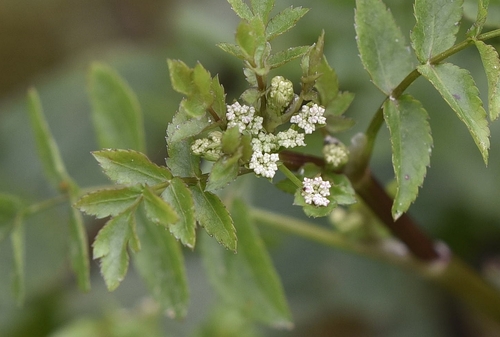
About Helosciadium nodiflorum (L.) W.D.J.Koch
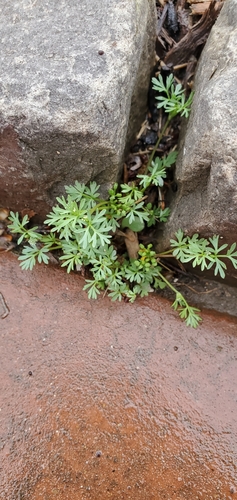
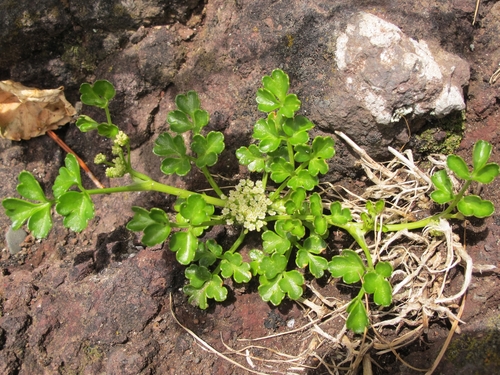
Helosciadium nodiflorum is a hairless, low-growing or prostrate perennial, reaching up to 1 meter in height. It has a thick, hollow, faintly ridged stem that produces roots at the nodes when it lies procumbent along the ground. Its leaves are glossy and pinnate, with 4 to 6 opposite pairs of toothed, oval to lanceolate leaflets that are slightly paler green on their undersides. The leaflet nodes have ridges that are often paler than the leaf rhachis, appearing as rings; this feature distinguishes it from lesser water-parsnip, which has a ring on its petiole instead. The petioles are hollow, with a distinctive single groove on their upper surface, and may be streaked with red or purple lines. They inflate laterally towards their base and clasp the stem. Crushed leaves of this species have a carrot scent. In terms of distribution and habitat, Helosciadium nodiflorum is common throughout England, Wales and Ireland, but far less common in Scotland. It often grows alongside watercress in wet locations. It flowers in July and August, and occurs in wet habitats including ditches, springs, fens and ponds. It is also widely recorded from brackish estuarine and salt marsh habitats. This species, commonly known as wild fool's watercress, has traditionally been harvested and eaten in several Mediterranean countries: Spain, Italy, Portugal and Morocco. Its edible young leaves and tender shoots can be eaten raw in salads, boiled, or used as a condiment in soups and other dishes.